
Why Inclusive Livelihood Programs Work Better Than One-Time Donations
Corporate Social Responsibility has evolved. What used to be about writing checks, hosting outreach days, or distributing relief goods is now being questioned by the very leaders who once championed those efforts. The question is no longer “Are we doing CSR?” but “Is our CSR actually changing lives?”
This is where the conversation becomes uncomfortable—and necessary.
Because while donations and short-term aid address immediate needs, they often fail to solve the deeper problem: long-term economic exclusion, especially among Persons with Disabilities (PWDs). In the Philippines, this gap is wide, persistent, and largely invisible.
And yet, the solution is surprisingly clear.
The Hard Truth About Traditional CSR
To be fair, traditional CSR has done good. Disaster relief, medical missions, feeding programs—these save lives in moments of crisis. But when it comes to breaking cycles of poverty and exclusion, especially for PWD communities, the impact is often temporary.
Studies consistently show that:
- One-time aid improves conditions for days or weeks
- Livelihood-based interventions improve conditions for years
- Skills and employment reduce dependence on future aid
According to international development data, livelihood programs are up to 4–5 times more effective in sustaining household income compared to short-term assistance alone.
This does not mean donations are bad.
It means donations are incomplete.
For CSR leaders seeking lasting impact, the question becomes:
What happens after the donation is spent?
PWDs: The Most Overlooked Sector in CSR
The Philippines has over 1.44 million registered Persons with Disabilities, and experts agree this number is underreported. More than half are of working age, yet less than 15% are gainfully employed.
Not because they lack ability.
But because opportunities are rarely designed with them in mind.
PWDs face:
- Limited access to training
- Workplace environments that are not inclusive
- Deep-rooted stereotypes about productivity
- Few livelihood options that match their abilities
Ironically, PWDs are often included in CSR programs as recipients—but rarely as contributors.
This is the gap inclusive livelihood programs are designed to fill.
Why Livelihood-Based CSR Works Better
Livelihood programs don’t treat PWDs as beneficiaries.
They treat them as partners in value creation.
When CSR supports livelihood programs for PWDs, several things happen at once:
- Income replaces dependency
Regular work creates predictable income, allowing families to plan, save, and invest. - Dignity replaces charity
Employment restores self-worth. This psychological shift is often more powerful than financial aid. - Skills replace vulnerability
Training equips PWDs with abilities that remain long after CSR funding ends. - Communities replace isolation
Work fosters social connection, collaboration, and belonging.
Research supports this. A 2023 livelihood impact assessment revealed:
- 80% of PWDs in livelihood programs reported improved mental well-being
- 72% developed stronger social networks
- 69% experienced increased confidence and independence
These outcomes cannot be achieved through donations alone.
The CSR Shift: From “Helping” to “Empowering”
Modern CSR leaders are moving away from optics-driven programs toward empowerment-driven models. This is especially true among organizations preparing ESG reports, sustainability disclosures, or long-term impact metrics.
Livelihood programs offer:
- Clear, measurable outcomes
- Repeatable impact
- Multi-year benefits
- Alignment with Sustainable Development Goals (SDGs)
For PWD-focused CSR, livelihood programs directly support:
- Decent Work and Economic Growth
- Reduced Inequalities
- Sustainable Communities
- Mental Health and Well-being
In short, livelihood-based CSR checks both the heart and the metrics boxes.
Where Hands in Harmony Fits In
Hands in Harmony exists precisely at this intersection—where compassion meets structure, and where CSR intent turns into real livelihood outcomes.
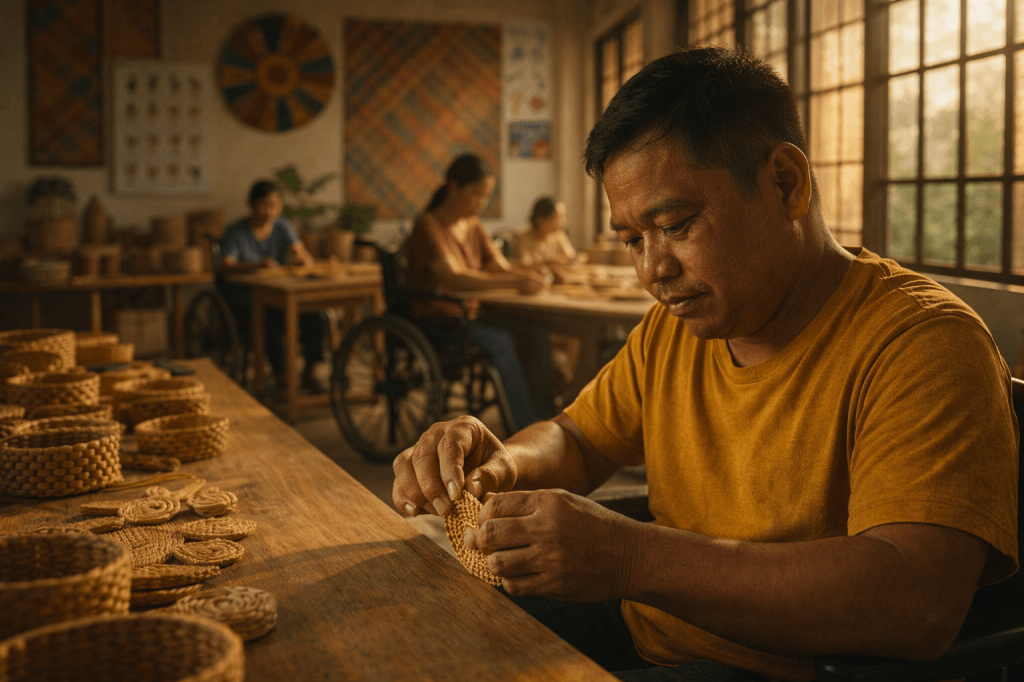
The program trains and supports Persons with Disabilities to produce high-quality, market-ready products. These are not “charity items.” They are thoughtfully crafted goods designed for real consumers, corporate clients, and institutional partners.
What makes Hands in Harmony effective for CSR partnerships is its model:
- PWDs receive skills training, not handouts
- Work is structured, dignified, and consistent
- Income is earned, not given
- Products are competitive in quality and presentation
For CSR teams, this means:
- Your support directly funds livelihoods
- Your participation creates jobs, not dependency
- Your impact can be tracked, reported, and sustained
This is CSR that doesn’t end when the calendar year closes.
Why Companies Are Rethinking Their CSR Strategy
There is a growing realization among CSR and sustainability leaders: short-term good will is no longer enough.
Employees, customers, and stakeholders are paying attention.
Recent studies show:
- 64% of employees prefer working for companies with meaningful social impact
- 71% of consumers trust brands more when CSR creates real economic opportunity
- Inclusive companies outperform peers by up to 28%
PWD livelihood programs do something rare:
They improve lives and strengthen corporate credibility.
They allow companies to say, truthfully:
“We don’t just donate. We empower.”
From Annual Donations to Long-Term Partnerships
One of the strongest advantages of livelihood-based CSR is continuity.
Instead of:
- Annual one-off donations
- Seasonal outreach programs
- Short-lived campaigns
Companies can build:
- Long-term livelihood partnerships
- Recurring procurement or gifting programs
- Measurable social impact pipelines
Hands in Harmony enables this shift by allowing companies to integrate CSR into:
- Corporate gifting
- Employee engagement initiatives
- Community development programs
- Supplier diversity efforts
This transforms CSR from an expense into an ecosystem of impact.
The Human Impact Behind the Numbers
Behind every livelihood statistic is a person.
A PWD who now contributes to household income.
A parent who no longer depends entirely on relatives.
A young adult who feels seen, capable, and valued.
Livelihood programs restore more than finances.
They restore identity.
And when CSR enables that transformation, the impact goes far beyond annual reports.
What Forward-Thinking CSR Leaders Are Asking Now
The most progressive CSR leaders are no longer asking:
- “How much should we donate?”
They are asking:
- “How do we create lasting impact?”
- “How do we empower, not enable dependency?”
- “How do we include sectors that are often left behind?”
PWD livelihood programs provide clear answers.
They are practical.
They are scalable.
They are human.
A Better Way Forward
CSR does not need to abandon donations—but it must evolve beyond them.
Inclusive livelihood programs offer a way to:
- Respect dignity
- Build independence
- Strengthen communities
- Deliver measurable impact
Hands in Harmony represents this next chapter of CSR—one where companies don’t just give, but build.
And the most meaningful CSR stories in the coming years will not be about how much was donated—but about how many lives were changed through opportunity.
So here’s the real question for CSR leaders and advocates alike:
If your CSR budget could create lasting livelihoods instead of temporary relief, why wouldn’t you choose that path?
 Hands in Harmony
Leave a comment