
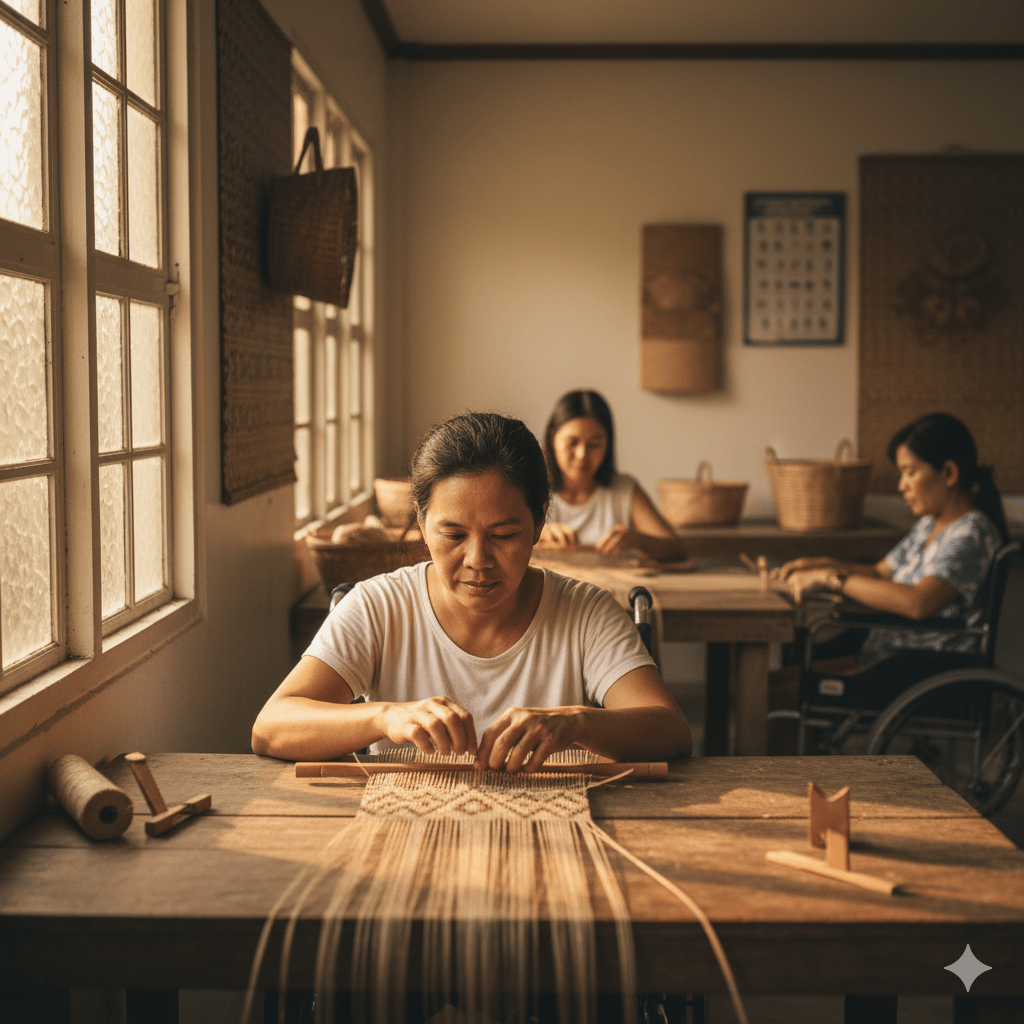
I didn’t hear about inclusive CSR from a keynote speaker or a sustainability report. I encountered it in a simple room filled with wooden tables, woven materials, and quiet focus. No banners. No speeches. Just people working.
One man sat near the window. He moved a little slower than the others, but his hands were precise. Every movement had intention. He wasn’t asking for help. He wasn’t waiting for instructions. He was producing something of value.
That moment stayed with me longer than any CSR presentation ever had.
Because suddenly, CSR stopped being abstract. It stopped being about budgets, calendars, and compliance. It became about dignity.
And that’s when I realized something uncomfortable but true: many CSR programs are generous, but very few are transformative.
For years, we’ve been trained to associate CSR with giving. Donations. Relief goods. Outreach days. All well-intentioned. All necessary in moments of crisis. But over time, something gets lost when CSR ends the moment the donation is spent.
The people return to waiting.
The families return to uncertainty.
And the system quietly resets to where it started.
I’ve seen this pattern repeat itself—especially among Persons with Disabilities.
PWDs are often included in CSR activities, but rarely in economic ones. They receive aid, but not opportunity. Support, but not trust. Visibility, but not voice.
And yet, when you watch a PWD at work, something becomes obvious very quickly: the problem was never ability. It was access.
There are more than 1.44 million registered Persons with Disabilities in the Philippines, and experts agree the real number is higher. More than half are of working age. Yet only a small fraction are meaningfully employed.
Not because they lack skill.
Not because they lack discipline.
But because systems were never built with them in mind.
So when a livelihood program works—when it genuinely equips, trains, and integrates PWDs into value creation—it doesn’t just change income. It changes identity.
I’ve spoken with PWD artisans who said the same thing in different ways:
“Ngayon, may silbi ako.”
“Hindi na ako umaasa.”
“May ambag na ako sa pamilya ko.”
Those words don’t show up in CSR metrics. But they are the metrics that matter.
This is where livelihood-based CSR quietly outperforms one-time donations.
A donation solves a moment.
A livelihood changes a trajectory.
Studies consistently show that livelihood programs create longer-lasting improvements in household stability, mental health, and community participation. In fact, assessments reveal that:
– Over 80% of PWDs in livelihood programs report improved self-confidence
– More than 70% experience better mental well-being
– Families gain more predictable income and planning ability
But beyond the data, there’s a visible shift you can’t quantify easily.
People stand differently when they earn.
They speak differently when they contribute.
They dream differently when the future feels possible.
That shift is what inclusive CSR makes possible.
I saw this clearly through Hands in Harmony.
What struck me wasn’t just the craftsmanship—though the quality speaks for itself. It was the atmosphere. There was no sense of charity in the room. No one was being “helped.” Everyone was being trusted.
PWD artisans were trained, not pitied.
Supported, not sheltered.
Expected to deliver quality, just like anyone else.
And they did.
That’s the quiet genius of livelihood-based CSR: it raises expectations, not dependency.
For companies, this kind of CSR creates something rare.
It creates stories employees believe in.
Stories customers trust.
Stories communities remember.
I’ve seen teams feel prouder talking about a livelihood partner than about a donation drive. Not because the donation was wrong—but because the livelihood felt real. Tangible. Human.
Employees could point to a product and say, “Someone made this.”
Not “We gave something away,” but “We helped build something.”
That distinction matters more than we think.
Because people today—especially younger employees and consumers—are deeply allergic to performative CSR. They want authenticity. They want continuity. They want to see that impact didn’t disappear after the photo-op.
Livelihood programs offer that continuity.
What also surprised me was how inclusive CSR quietly strengthens organizations internally.
When companies support dignity-based programs, employees don’t just feel proud—they feel aligned. Retention improves. Engagement rises. Conversations about purpose stop feeling forced.
Inclusive CSR stops being an obligation and starts becoming part of culture.
And that’s why more leaders are rethinking how they define “impact.”
They’re asking better questions now:
Are we helping people stand on their own?
Are we building skills that last beyond us?
Are we empowering communities—or just passing through them?
Those questions lead naturally to livelihood programs.
Hands in Harmony doesn’t position itself as a charity. And that matters.
It positions itself as a bridge—between companies that want meaningful CSR and PWD communities that want meaningful work. It allows organizations to participate in impact without creating dependency, and without adding operational complexity.
For CSR leaders, this is crucial.
It means impact that is:
– Measurable
– Repeatable
– Dignified
– Sustainable
And most importantly, human.
I often think back to that man near the window.
He didn’t know he was part of a CSR story.
He wasn’t trying to inspire anyone.
He was just doing his job well.
And that, I think, is the clearest sign of CSR done right.
When people stop feeling like beneficiaries—and start feeling like contributors—impact becomes permanent.
So maybe the real question for CSR leaders isn’t how much to give this year.
Maybe it’s this:
What kind of future do we want our responsibility to help people build?
Because the most meaningful CSR doesn’t end with generosity.
It begins with trust.
 Hands in Harmony
Leave a comment