
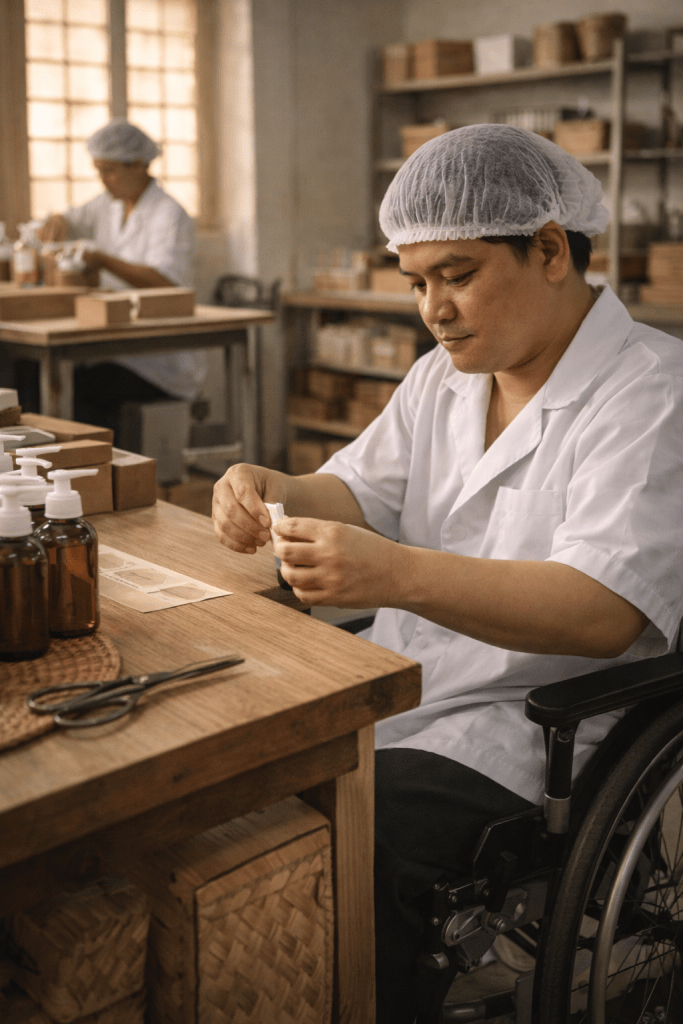
The problem wasn’t a lack of kindness.
For years, people with disabilities were surrounded by well-meaning support—donations, assistance programs, short-term help. Everyone wanted to do the right thing. And yet, many of the same people remained unemployed, dependent, and quietly sidelined.
If you asked them what they wanted, the answer was simple:
A chance to work.
A chance to contribute.
A chance to be useful.
But the system kept getting in the way.
Resumes filtered them out.
Interviews judged them before they spoke.
Employers hesitated, not because of facts, but because of fear.
And so an entire group of capable people was left waiting—not for help, but for opportunity.
When the System Decides Before the Person Is Seen
For Persons with Disabilities, the biggest obstacle has never been ability. It has been access.
Many were told, directly or indirectly, that work might be “too hard,” “too risky,” or “too complicated” for them. Some were encouraged to be grateful for assistance instead of being trusted with responsibility.
Over time, this does more than limit income.
It limits identity.
Work is not just about earning money. It is about purpose, pride, and belonging. When people are denied work, they are denied a role in society.
And this problem isn’t unique to one country or culture. It’s global.
Which makes the next part of the story so important.
The Radical Idea That Changed Everything
In New York, a small bakery decided to challenge this pattern.
Instead of asking, “Is this person qualified?”
They asked a different question: “Is this person ready to work?”
Greyston Bakery removed resumes, interviews, and background checks from their hiring process. Anyone could put their name on a list. When a position opened, the next person was hired—no judgment, no screening, no assumptions.
This approach became known as Open Hiring.
For people with disabilities, this changed everything.
They were no longer applicants begging for approval.
They were workers trusted with responsibility.
Training happened on the job. Support was built around people instead of used to exclude them.
It was a simple idea—but a powerful one.
Trust Came First. Skills Followed.
Critics were skeptical.
Would quality suffer?
Would productivity drop?
Would the business survive?
What happened instead surprised everyone.
The bakery met its production standards.
Employee retention improved.
Workplace pride increased.
Eventually, the bakery became the official brownie supplier for Ben & Jerry’s—one of the most recognized ice cream brands in the world.
That partnership answered a question many people were afraid to ask out loud:
Can people with disabilities really contribute at the same level?
The answer was clear.
Yes. When given the chance.
What Work Gave Back That Aid Never Could
For workers with disabilities, the impact went far beyond a paycheck.
Stable income meant families could plan.
Routine meant days had structure.
Contribution meant dignity returned.
People who had been labeled “unemployable” became:
- Skilled workers
- Breadwinners
- Taxpayers
- Contributors to their community
Dependence on assistance decreased. Confidence increased. Identity was restored.
This wasn’t charity.
This was participation.
And participation changes how people see themselves—and how society sees them.
Why This Story Matters Beyond One Bakery
This story is not really about baked goods.
It’s about what happens when we stop protecting people from work and start opening doors to it.
It shows that:
- Ability often grows after opportunity is given
- Trust can come before proof
- Inclusion does not lower standards—it raises people
Most importantly, it proves that livelihood is one of the most powerful forms of support.
Not because it feels good—but because it works.
The Lesson for Social Causes and Supporters
Many people who care about social causes genuinely want to help Persons with Disabilities. But help that ends quickly often leaves people waiting for the next round of support.
Livelihood does something different.
It creates independence.
It builds confidence.
It allows people to stand on their own.
Programs like Hands in Harmony follow the same principle locally—placing products and quality first, and allowing livelihood to grow naturally from real work.
PWDs are not positioned as beneficiaries.
They are positioned as producers.
And that distinction makes all the difference.
From Helping to Trusting
The biggest shift in this story is not operational.
It’s mental.
The shift from:
“We need to help them”
to
“We trust them to contribute.”
When society makes that shift, people with disabilities don’t just survive.
They participate.
They create.
They build livelihoods.
And society becomes stronger because of it.
A Quiet Invitation
If you care about social causes…
If you believe people deserve dignity, not dependency…
If you want your support to last longer than a moment…
Consider how you support.
Support work.
Support products made with care.
Support social enterprises that trust people to contribute.
You don’t need to feel sorry to make a difference.
Sometimes, the most powerful support is simply choosing to believe people can do the work.
And when you support livelihoods, you don’t just help people get by.
You help them belong.
 Hands in Harmony
Leave a comment