
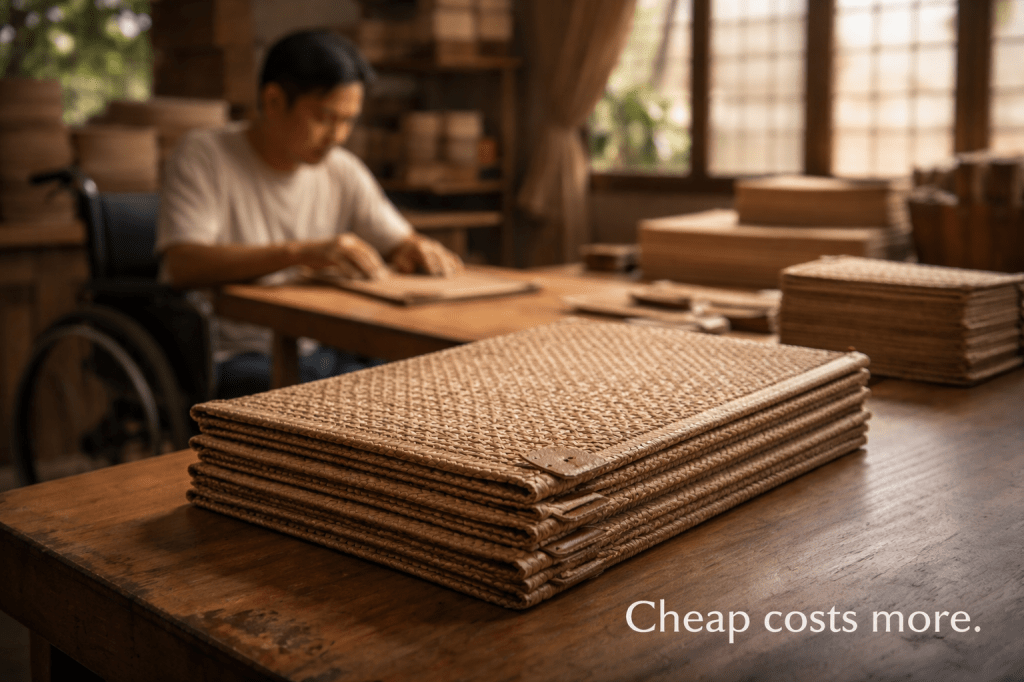
The problem usually starts with a “good deal.”
The price looks right. The supplier promises fast delivery. The product checks all the boxes—at least on paper. You approve the order, confident you saved money.
Then the product arrives.
At first glance, it seems fine. But weeks later, something changes. The material wears faster than expected. The finish doesn’t hold. The next batch looks slightly different. Suddenly, you’re ordering replacements, filing complaints, or explaining to someone else why the quality didn’t hold up.
That’s when the realization hits:
Cheap didn’t actually save anything.
It just delayed the cost.
Why “Affordable” Products End Up Being Expensive
Most people think cost is about price per unit.
But anyone who has handled purchasing—whether for a business or a household—knows that’s only part of the story.
The real cost of cheap products shows up quietly, over time:
- Reordering sooner than expected
- Paying twice for something that should’ve lasted
- Losing time fixing problems you didn’t cause
- Explaining quality issues to clients, guests, or managers
None of these show up on the invoice.
But they show up in stress, time, and reputation.
And the frustrating part?
These problems are incredibly common.
The Root of the Problem Isn’t the Product—It’s the Process
When you step back, a pattern becomes obvious.
Cheap products often come from:
- Rushed production
- Inconsistent quality checks
- High worker turnover
- Little pride in the finished output
The goal isn’t to make something well.
It’s to make it fast—and move on to the next order.
That’s why the first batch is usually acceptable.
And why the second or third batch becomes a gamble.
Consistency requires discipline.
Discipline costs time.
And time is often the first thing cut when price is the main selling point.
The Shift Smart Buyers Are Quietly Making
At some point, many buyers stop asking,
“How cheap can this be?”
And start asking,
“How long will this actually last?”
This shift changes everything.
Instead of chasing discounts, they look for:
- Products that perform the same every time
- Suppliers who follow a clear process
- Items that don’t need explaining or apologizing for
- Reliability they can count on without supervision
The goal is no longer the lowest price.
It’s lowest long-term cost.
And that usually comes from buying fewer, better things.
When Buying Better Finally Felt Easier
That’s exactly what happened to us.
After too many disappointing reorders, we tried a different approach. We worked with a small supplier whose products weren’t the cheapest—but promised consistency.
No dramatic pitch.
No big claims.
Just a quiet confidence in how things were made.
The first order arrived. It was solid. Clean. Well-finished.
But again, the real test wasn’t the first order.
It was the second.
Same quality.
Same details.
Same finish.
Then the third.
No surprises.
No excuses.
That’s when the math finally made sense.
We weren’t spending more.
We were wasting less.
Why These Products Stayed Reliable
Over time, it became clear why the products held up.
The production wasn’t rushed.
Each step followed a set process.
Quality checks didn’t depend on mood or deadlines.
The people making the products weren’t rotating constantly. They knew the work. They respected the standard. They took pride in doing things properly.
In a market where shortcuts are common, this kind of discipline stood out.
And it explained why we stopped worrying about reorders.
The Part We Learned Later (That Explained Even More)
Only later did we learn something we hadn’t been told upfront.
The products were made under a livelihood program by Persons with Disabilities.
This wasn’t highlighted as a selling point.
There was no emotional appeal.
It was simply part of how the operation worked.
And suddenly, the consistency made even more sense.
People who had stable work.
Clear routines.
Defined processes.
They weren’t rushing through tasks.
They were focused on doing them right.
Not because they had to—but because the work mattered.
Why This Detail Matters—But Doesn’t Need to Lead the Story
Here’s what’s important.
We didn’t choose the products because they were made by PWDs.
We chose them because they performed well.
The livelihood behind them wasn’t the reason.
It was the reason they worked so well.
And that distinction is crucial.
When products depend on sympathy to sell, support fades.
When products stand on quality, demand sustains livelihoods naturally.
That’s how impact lasts—quietly, without pressure.
What Changed in How We Think About “Value”
This experience reshaped how we define value.
Value isn’t just:
- Low price
- Quick delivery
- Attractive packaging
Real value is:
- Consistency
- Reliability
- Fewer replacements
- Less stress
And when quality holds up over time, the extra benefit—supporting livelihoods—becomes meaningful, not forced.
The Outcome Nobody Had to Be Persuaded Into
Because buyers kept coming back, something important happened behind the scenes.
Work became predictable.
Income became stable.
Planning became possible.
There was no need for campaigns.
No need for reminders.
Support flowed naturally—from repeat orders.
That’s the quiet strength of buying better.
A Smarter Way to Spend Without Spending More
If you care about social causes or supporting Persons with Disabilities, here’s the truth:
You don’t need to buy for a cause.
You just need to buy well.
Choose products that:
- Hold up
- Stay consistent
- Respect your time and standards
When those products also come from social enterprises or PWD livelihood programs, the impact takes care of itself.
No guilt.
No pressure.
Just good judgment.
Why Smart Buyers Are Walking Away from Cheap
Cheap products promise savings.
Reliable products deliver them.
And more people are realizing this:
Buying better isn’t indulgent.
It’s efficient.
It reduces waste, stress, and repeat costs—while quietly supporting people who take their work seriously.
Sometimes, the most responsible choice isn’t the loudest one.
It’s simply choosing products that don’t fail you after the first order.
And sticking with them.
 Hands in Harmony
Leave a comment