
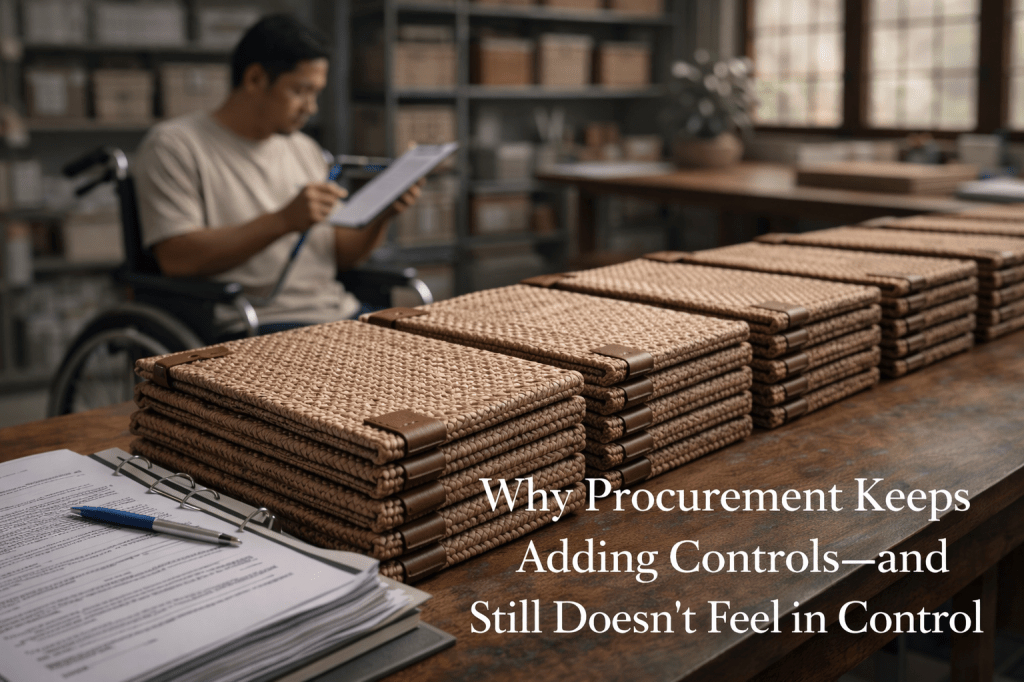
By the time the third approval layer is added, procurement already knows something is wrong.
The Control Paradox
It usually starts after a surprise.
A delivery arrives late.
A batch looks slightly different.
A supplier misses a detail that was “clearly specified.”
Nothing catastrophic—but enough to trigger discomfort.
So procurement responds the only way it knows how.
Add a checkpoint.
Add a sign-off.
Add a report.
Add a clause.
Control increases. Confidence doesn’t.
And that’s the paradox many procurement teams now live in:
the more controls they add, the less in control they feel.
When Governance Becomes a Coping Mechanism
On paper, modern procurement looks airtight.
Multi-layer approvals.
Detailed SOPs.
Vendor scorecards.
Compliance dashboards.
Yet behind closed doors, many procurement leaders will admit the same thing:
“We’re doing more work than ever just to keep things from falling apart.”
That’s not a failure of governance.
It’s a signal of something deeper.
Controls are not being used to optimize systems.
They’re being used to compensate for instability.
The Quiet Cost of Too Many Controls
Every additional control has a cost.
Not always financial—but operational.
Controls slow decisions.
They dilute accountability.
They turn procurement into a policing function.
Instead of designing supply systems, teams end up managing exceptions.
And worst of all, controls create a false sense of safety.
Because they react after something goes wrong.
Control Doesn’t Prevent Risk—Stability Does
Here’s the uncomfortable truth most procurement professionals eventually discover:
Controls don’t stop problems.
They document them.
If a supplier’s execution environment is unstable, controls will multiply endlessly—and still fail.
Why?
Because instability is not a compliance issue.
It’s a systems issue.
Where Instability Actually Comes From
Inconsistent supplier performance almost always traces back to the same roots:
- High workforce turnover
- Work done differently depending on who’s present
- Processes that exist on paper but not in habit
- Quality checks that happen after mistakes, not before
In these environments, controls feel necessary—but they’re always one step behind reality.
Procurement ends up managing symptoms, not causes.
What High-Maturity Procurement Teams See Differently
At a certain level of experience, procurement leaders stop asking:
“Do we have enough controls?”
And start asking:
“Why do we need so many controls in the first place?”
That question changes everything.
Because mature procurement understands one thing clearly:
The best suppliers don’t need to be controlled.
They need to be stable.
Stability Changes the Role of Procurement
When execution environments are stable, procurement behavior shifts naturally.
Fewer approvals are needed.
Escalations drop.
Monitoring becomes lighter.
Procurement moves from:
- Enforcer → Designer
- Gatekeeper → Partner
- Firefighter → Strategist
Control doesn’t disappear.
It becomes invisible.
A Different Kind of Supplier Experience
We saw this firsthand after years of managing suppliers who looked compliant—but behaved inconsistently.
Eventually, we worked with a production partner whose operations felt almost boring.
Same people.
Same workflow.
Same output.
First order: correct.
Second order: identical.
Third order: no conversation needed.
No controls were removed intentionally.
They simply became unnecessary.
The Detail That Made It All Click
Only later did we learn something unexpected.
Much of the workforce behind the operation consisted of Persons with Disabilities, employed through a structured livelihood model.
This wasn’t positioned as a CSR initiative.
It wasn’t highlighted in negotiations.
It was simply how the system was built.
And suddenly, the stability made sense.
Why Livelihood Stability Reduces the Need for Control
Here’s what procurement teams rarely get visibility into:
When people depend on work for long-term livelihood:
- They stay longer
- They master routines
- They protect processes
- They value consistency
PWD artisans weren’t rotating out every few months.
They weren’t treating the work as temporary.
They were invested.
And investment changes execution behavior more powerfully than oversight ever could.
This Is Not About Charity
It’s important to be precise here.
Performance didn’t improve because of goodwill.
It improved because systems became stable.
The livelihood model didn’t lower standards.
It reinforced them.
For procurement, this distinction matters deeply.
Because this isn’t a social story.
It’s an operational one.
When Controls Shrink, Confidence Grows
As execution stabilized, something interesting happened.
Controls didn’t need to be enforced.
They simply existed in the background.
Procurement teams felt:
- Less exposed
- More confident
- Less reactive
- More strategic
Not because risk disappeared—but because it was designed out of the system.
The Procurement Insight That Changes Everything
If you lead procurement, here’s the shift that matters most:
Stop asking how to control suppliers better.
Start asking how to select systems that don’t require control.
Evaluate:
- Workforce stability
- Process discipline
- Habitual execution
- Ownership tied to outcomes
Suppliers that invest in people protect process.
Suppliers that protect process reduce risk.
Why Fewer Controls Can Mean Stronger Procurement
Great procurement doesn’t look busy.
It looks calm.
It doesn’t escalate often.
It doesn’t explain much.
It doesn’t surprise stakeholders.
And that calm doesn’t come from more dashboards.
It comes from sourcing partners whose execution environments are built for repeatability.
The Best Control System Is the One You Don’t Notice
In the end, the most effective procurement controls are invisible.
They’re embedded in:
- Stable teams
- Repeated routines
- Clear ownership
- Work that people care about protecting
When those elements are present, controls fade into the background—where they belong.
Because procurement was never meant to manage anxiety.
It was meant to design reliability.
And sometimes, the most powerful way to regain control
is to stop adding it—and start choosing better systems.
 Hands in Harmony
Leave a comment