
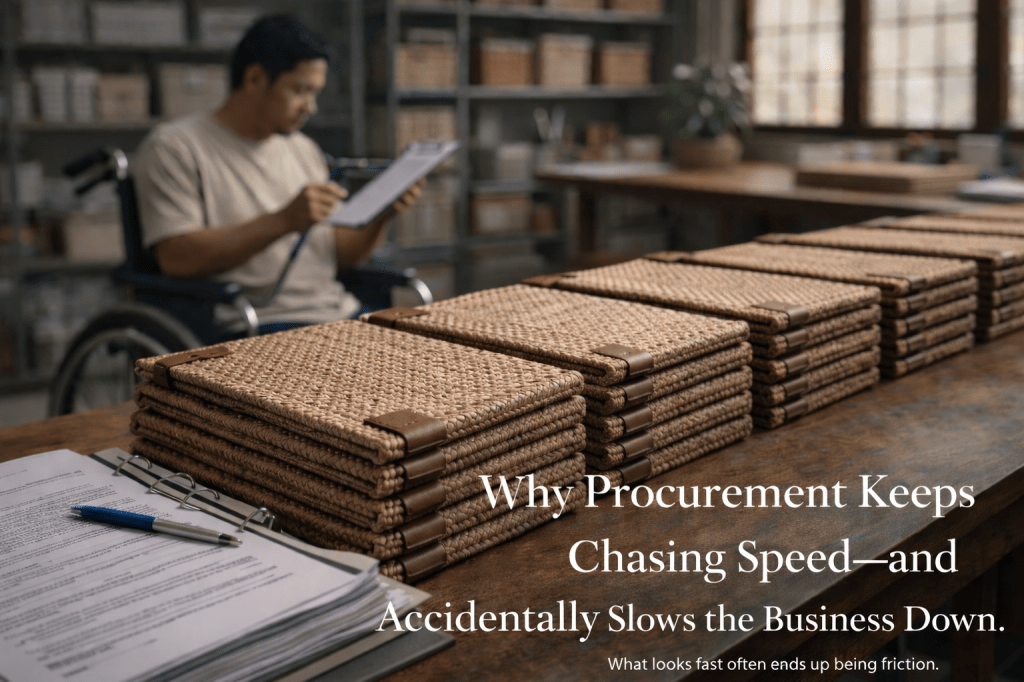
The pressure usually comes wrapped in a single word.
Faster.
Faster sourcing.
Faster onboarding.
Faster approvals.
Procurement hears it from leadership, operations, and finance—sometimes all at once. And in response, teams compress timelines, push suppliers harder, and tighten SLAs.
On paper, everything looks quicker.
And yet, inside the organization, something strange happens.
It doesn’t feel fast.
When “Fast” Becomes the Only Metric That Matters
At first, speed sounds reasonable. Competitive even.
Markets move quickly. Demand changes overnight. Delays feel expensive. So procurement optimizes for velocity.
Shorter sourcing cycles.
Quicker decisions.
Faster deliveries.
But over time, the organization starts paying a different kind of price.
Rework increases.
Escalations rise.
Exceptions pile up.
And suddenly, teams are spending more time fixing problems than moving forward.
That’s when the question quietly surfaces:
If everything is faster, why does execution feel slower?
Speed at the Front End, Delay at the Back End
Most procurement leaders eventually recognize the pattern.
Speed gained early in the process often shows up as delay later.
A rushed supplier skips steps.
A compressed timeline cuts corners.
A quick decision introduces uncertainty.
The result isn’t immediate failure.
It’s friction.
And friction spreads.
Operations pauses to adjust.
Quality steps in to recheck.
Management gets pulled into explanations.
What looked like speed at the beginning becomes drag at the end.
Why Procurement Mistakes Urgency for Velocity
Urgency is loud.
Velocity is quiet.
Urgency pushes.
Velocity flows.
But under pressure, procurement often treats them as the same thing.
Urgency creates movement—but not direction.
Velocity creates progress—but only when systems are stable.
When procurement optimizes for urgency alone, it creates motion without flow.
Things move.
But they don’t move smoothly.
The Real Reason Speed Backfires
Speed doesn’t fail because people work too slowly.
It fails because systems aren’t ready to absorb it.
Unstable execution environments can’t handle compression.
Common symptoms include:
- Work done differently depending on who’s present
- Processes that break under pressure
- Quality checks that react instead of prevent
- Teams that improvise when timelines shrink
When these conditions exist, speed magnifies problems instead of eliminating them.
Procurement isn’t accelerating the business.
It’s accelerating instability.
Why Pushing Suppliers Harder Rarely Works
When speed becomes the priority, suppliers respond predictably.
They promise faster delivery.
They stretch capacity.
They rush output.
Short-term results look positive.
But underneath, the system weakens.
People rotate.
Processes bend.
Consistency erodes.
Procurement thinks it’s gaining time.
In reality, it’s borrowing it—from the future.
What High-Maturity Procurement Teams Understand
At a certain point, experienced procurement leaders stop asking:
“How can we go faster?”
And start asking:
“What is slowing us down later?”
That shift reframes speed entirely.
Instead of compressing timelines, they focus on:
- Repeatable execution
- Stable workflows
- Suppliers who perform the same way under pressure
They understand something critical:
Real speed is a byproduct of stability.
When Work Finally Started Moving Faster
We experienced this shift after years of pushing for speed and paying for it downstream.
Eventually, we partnered with a supplier whose operations felt… calm.
Not slow.
Not rigid.
Just steady.
Orders moved through the system without urgency.
Deliveries arrived without drama.
Issues didn’t snowball.
Lead times didn’t magically shrink overnight.
But something else happened.
The overall process sped up.
Why Flow Beat Rush Every Time
The difference wasn’t effort.
It was flow.
The same people did the same work.
Processes didn’t change daily.
Quality checks were built into the routine.
No one was scrambling.
No one was improvising.
Work moved because nothing interrupted it.
And interruptions—not effort—are what slow organizations down.
The Detail That Explained the Consistency
Only later did we learn something that reframed the entire experience.
Much of the production team consisted of Persons with Disabilities, employed through a structured livelihood program.
This wasn’t highlighted in negotiations.
It wasn’t framed as a social initiative.
It was simply how the operation was built.
And suddenly, the rhythm made sense.
Why Stable Livelihoods Create Real Speed
Here’s the connection procurement teams rarely get to observe closely.
When people rely on work for long-term livelihood:
- Turnover drops
- Skills deepen
- Routines strengthen
- Process discipline holds under pressure
PWD artisans weren’t rotating out.
They weren’t rushing to move on.
They stayed.
And when people stay, work flows.
That flow—quiet, uninterrupted, repeatable—is what creates real speed.
Why This Isn’t a CSR Story
It’s important to be precise.
Performance didn’t improve because of goodwill.
It improved because systems became stable.
The livelihood model didn’t slow production.
It removed friction.
This isn’t about empathy improving outcomes.
It’s about structure eliminating interruption.
For procurement, that distinction matters.
What Changed When Procurement Stopped Chasing Speed
As stability increased, several things happened naturally.
Fewer exceptions.
Less rework.
Lower escalation.
Procurement spent less time reacting and more time planning.
Cycle times shortened—not because steps were removed, but because interruptions disappeared.
The business felt faster—without anyone rushing.
The Procurement Insight That Reframes Speed Forever
If you lead procurement, here’s the shift that changes everything:
Stop optimizing for urgency.
Start optimizing for flow.
Evaluate suppliers not on how fast they promise—but on:
- Workforce stability
- Process discipline
- Consistency under pressure
- Ability to absorb volume without disruption
Suppliers who rush will slow you down later.
Suppliers who flow will speed you up over time.
Why the Fastest Systems Don’t Feel Fast
The fastest procurement systems don’t look intense.
They look boring.
No emergencies.
No heroics.
No constant follow-ups.
Just work moving—quietly, predictably, reliably.
And behind that calm:
- Stable teams
- Repeated routines
- People who protect the work because the work protects them
The Speed Procurement Actually Needs
Procurement doesn’t need to move faster.
It needs to stop being interrupted.
Because speed isn’t about how quickly things start.
It’s about how rarely they have to stop.
And the organizations that understand this don’t chase speed at all.
They design systems where work flows—
and speed takes care of itself.
 Hands in Harmony
Leave a comment