
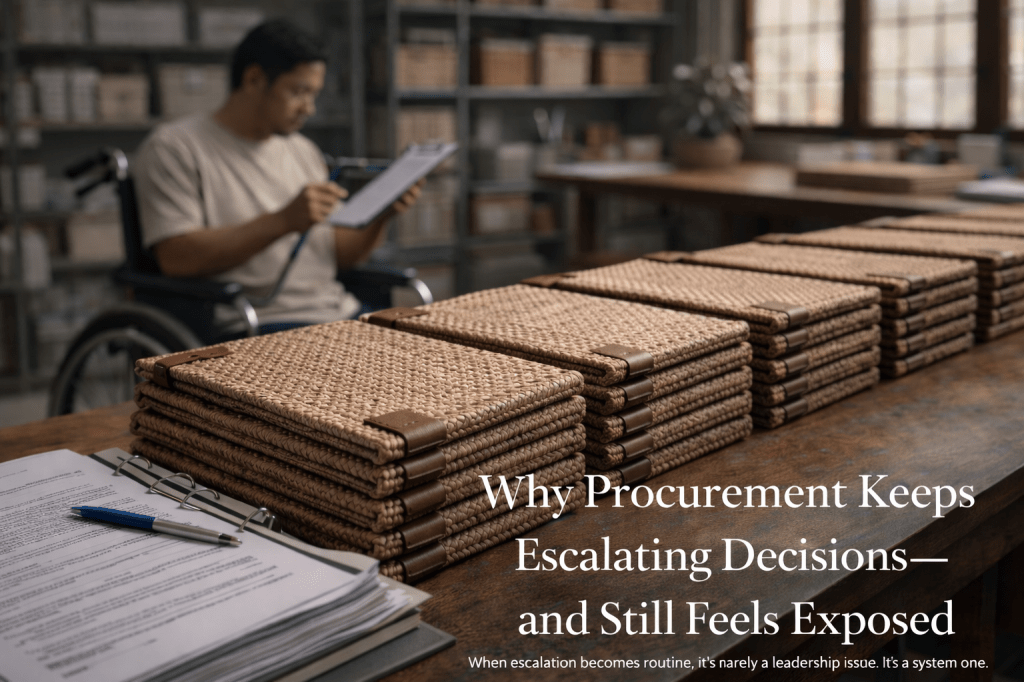
The first escalation usually feels reasonable.
A supplier misses a detail.
A delivery varies slightly.
A decision feels just risky enough to push upward.
So procurement escalates.
The second escalation feels cautious.
The third feels procedural.
By the tenth, escalation has become habit.
Soon, even routine decisions require approval.
Procurement slows down.
Managers hesitate.
Operations waits.
And despite all that caution, the feeling remains:
We’re still exposed.
When Escalation Becomes the Default
In many organizations, escalation is framed as good governance.
If something goes wrong, the logic goes, at least leadership was informed.
But over time, something subtle happens.
Escalation stops being a safety measure.
It becomes a coping mechanism.
Procurement teams escalate not because they lack authority—but because they lack confidence in what comes next.
The Hidden Cost of Escalation
Escalation is rarely tracked as a cost.
But it should be.
Every escalation:
- Delays decisions
- Dilutes accountability
- Pulls senior leaders into operational noise
- Turns procurement into a bottleneck
More importantly, escalation shifts behavior.
People stop deciding.
They start waiting.
Procurement becomes risk-averse not by choice—but by necessity.
Why Procurement Escalates Even When Authority Exists
This is where many organizations misdiagnose the problem.
They assume escalation happens because:
- Managers are inexperienced
- Teams lack confidence
- Authority isn’t clear
So they respond by:
- Clarifying approval limits
- Redefining decision rights
- Issuing new policies
And yet… escalation continues.
Because escalation is rarely about authority.
It’s about trust.
Escalation Is What Happens When the System Isn’t Trusted
Procurement escalates decisions when it doesn’t trust the system beneath them.
Past surprises linger.
- A supplier once slipped without warning
- A “minor” issue became a major problem
- Someone had to explain a decision after the fact
Over time, procurement learns a quiet lesson:
If something goes wrong, it’s safer to escalate than to decide.
This isn’t weakness.
It’s self-protection.
Why More Approvals Don’t Reduce Risk
Many organizations respond to escalation by formalizing it.
More sign-offs.
More committees.
More checkpoints.
But approvals don’t reduce risk.
They redistribute it.
The decision still exists.
The uncertainty still exists.
It just moves upward.
And as decisions move up, momentum slows.
Procurement becomes reactive.
Operations loses speed.
Leadership gets dragged into issues they shouldn’t be touching.
The Real Root Cause: Unstable Execution Environments
Escalation doesn’t start in procurement.
It starts in supplier behavior.
Inconsistent delivery.
Variable quality.
Unpredictable outcomes.
When execution is unstable, decisions feel heavier.
And when decisions feel heavy, they travel upward.
Escalation isn’t about caution.
It’s about compensating for instability.
What High-Maturity Procurement Teams See Clearly
At a certain level of experience, procurement leaders stop asking:
“Who should approve this?”
And start asking:
“Why does this decision feel unsafe in the first place?”
That question reframes everything.
Because when outcomes are predictable, decisions stay local.
When outcomes vary, decisions climb.
When Escalation Quietly Disappears
We saw this shift after working with a supplier whose performance felt different—not dramatic, just steady.
First order: correct.
Second order: identical.
Third order: no discussion needed.
Small decisions stayed small.
No one felt the need to escalate.
Not because rules changed—but because trust returned.
Why Trust Reduced Escalation More Than Policy Ever Did
Over time, the reason became clear.
The supplier’s execution environment was stable.
- The same people did the same work
- Processes didn’t change daily
- Quality checks were embedded, not reactive
Procurement didn’t need to “play it safe.”
The system already was.
The Detail That Explained the Stability
Only later did we learn something that reframed the entire experience.
Much of the workforce consisted of Persons with Disabilities, employed through a structured livelihood program.
This wasn’t highlighted.
It wasn’t used as leverage.
It was simply how the system was built.
And suddenly, the stability made sense.
Why Stable Livelihoods Reduce Escalation
Here’s the connection procurement teams rarely get to see directly.
When people rely on work for long-term livelihood:
- Turnover drops
- Skill mastery increases
- Process discipline strengthens
- Ownership becomes personal
PWD artisans weren’t treating the work as temporary.
They weren’t rushing to move on.
They protected the routine—because the routine protected their livelihood.
That kind of stability does more to reduce escalation than any approval matrix ever could.
This Is Not a Leadership Problem
It’s important to be clear.
Escalation isn’t happening because procurement leaders lack confidence.
It’s happening because systems lack reliability.
No amount of training will fix that.
No org chart adjustment will solve it.
Only execution stability does.
The Outcome Procurement Actually Wants
As supplier behavior stabilized, something important happened.
Decisions stayed where they belonged.
Procurement regained momentum.
Leadership got out of the weeds.
Risk didn’t disappear.
It became manageable.
And behind that stability:
- Workers had steady income
- Skills deepened
- Livelihoods were sustained through consistent demand
Impact followed performance—not the other way around.
The Procurement Insight That Changes Escalation Forever
If you lead procurement, here’s the shift that matters most:
Stop asking how to manage escalation better.
Start asking how to design it out of the system.
Evaluate suppliers not just on price and capacity—but on:
- Workforce stability
- Process discipline
- Repeatability under pressure
- Ownership of outcomes
Suppliers that are stable don’t push decisions upward.
They keep them grounded.
Why the Best Procurement Decisions Stay Quiet
Great procurement doesn’t announce itself.
It doesn’t escalate often.
It doesn’t explain much.
It doesn’t surprise anyone.
It just works.
And when execution environments are stable, procurement finally gets what it’s been trying to protect all along:
The confidence to decide.
Because escalation was never the goal.
Reliability was.
And reliability doesn’t come from permission.
It comes from systems that can be trusted—day after day, order after order.
 Hands in Harmony
Leave a comment