
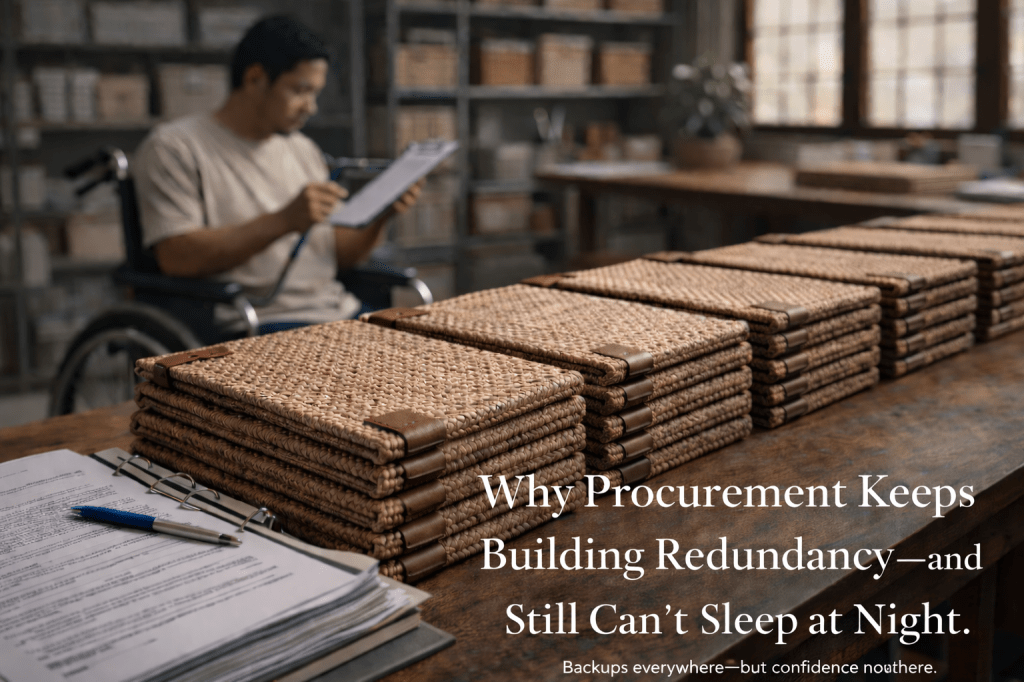
The anxiety usually sounds reasonable.
“What if this supplier fails?”
“What if demand spikes?”
“What if something breaks and we’re unprepared?”
So procurement responds the responsible way.
Add a backup supplier.
Approve a second and third option.
Build buffers.
Draft contingency plans.
On paper, the system looks safer.
Yet many procurement leaders will admit—quietly—that the worry doesn’t go away.
Even with all the redundancy in place, the unease remains.
When Safety Measures Don’t Feel Safe
Redundancy is supposed to bring peace of mind.
Multiple suppliers.
Alternative routes.
Fallback options.
But instead of reassurance, many teams experience the opposite.
More monitoring.
More coordination.
More exceptions.
Procurement spends its days managing coverage instead of confidence.
And the question lingers:
If we’ve built so many backups, why do we still feel exposed?
The Comfort of Options—and the Cost They Carry
Redundancy feels comforting because it offers choice.
If one supplier slips, another can step in.
If volume increases, it can be spread.
If something goes wrong, there’s an escape hatch.
But redundancy comes with a hidden trade-off.
When volume is divided:
- No supplier fully stabilizes
- Learning curves reset constantly
- Accountability diffuses
- Execution remains shallow
Suppliers never quite master the work—because they never own enough of it.
Why More Suppliers Can Mean Less Control
Procurement often assumes that more suppliers equal more resilience.
In reality, resilience depends on depth, not breadth.
Shallow relationships create:
- Inconsistent execution
- Frequent re-onboarding
- Repeated quality checks
- Continuous recalibration
Procurement doesn’t gain safety.
It gains complexity.
And complexity is not the same as resilience.
Redundancy Manages Fear, Not Performance
Here’s the uncomfortable truth.
Redundancy doesn’t usually exist because systems are strong.
It exists because systems aren’t trusted.
When execution feels unreliable, procurement compensates with options.
But options don’t fix instability.
They just mask it.
The underlying system remains fragile—now spread across multiple suppliers instead of concentrated in one.
The Illusion of Coverage
With enough suppliers on the list, it’s easy to feel prepared.
Until something actually happens.
Then procurement discovers:
- Backup suppliers don’t know the nuances
- Secondary vendors struggle with scale
- Tertiary options introduce new variance
In moments of stress, redundancy often reveals its limits.
What looked like coverage becomes coordination chaos.
What High-Maturity Procurement Teams Do Differently
At a certain point, experienced procurement leaders stop asking:
“How many backups do we have?”
And start asking:
“Why do we need so many backups in the first place?”
That question changes the strategy.
Instead of spreading risk thin, they focus on stabilizing execution deeply.
Fewer Suppliers, Stronger Systems
Mature procurement teams make a counterintuitive move.
They consolidate.
Not recklessly—but deliberately.
They choose:
- Fewer suppliers
- Deeper partnerships
- Greater volume per partner
- Clear accountability
With enough volume, suppliers invest properly.
Processes settle.
Teams specialize.
Standards stick.
Redundancy isn’t removed—it becomes unnecessary.
When Procurement Finally Slept Better
We saw this shift after years of building safety nets that never felt safe.
Eventually, we worked with a supplier that didn’t offer endless options—but offered consistency.
Same people.
Same process.
Same output.
As volume increased, execution improved instead of breaking.
Monitoring reduced.
Exceptions dropped.
Confidence grew.
For the first time, redundancy stopped feeling urgent.
The Detail That Made the Difference Clear
Only later did we learn something that reframed the entire experience.
Much of the production team consisted of Persons with Disabilities, employed through a structured livelihood model.
This wasn’t positioned as a CSR initiative.
It wasn’t used to justify performance.
It was simply how the system was built.
And suddenly, the stability made sense.
Why Stable Livelihoods Reduce the Need for Redundancy
Here’s the connection procurement teams rarely see clearly.
When people rely on work long-term:
- Turnover drops
- Skills compound
- Processes become habit
- Pride shifts toward consistency
PWD artisans weren’t rotating in and out.
They weren’t treating work as temporary.
They stayed.
And when people stay, systems stabilize.
Stability reduces surprises.
Surprises are what redundancy is meant to cover.
This Is Not an Argument Against Risk Management
To be clear, redundancy has its place.
True contingencies matter.
Single points of failure are dangerous.
But redundancy cannot replace execution confidence.
If every supplier is fragile, adding more fragility doesn’t create resilience.
It creates noise.
What Changed When Procurement Built Stability Instead of Coverage
As execution stabilized, something important happened.
Procurement didn’t need to plan for failure constantly.
It started planning for performance.
Supplier conversations shifted:
- From “What if something goes wrong?”
- To “How do we scale this reliably?”
Risk didn’t disappear.
It became manageable.
The Procurement Insight That Reframes Safety
If you lead procurement, here’s the shift that matters:
Stop asking how many backups you have.
Start asking how stable your primary system is.
Evaluate suppliers on:
- Workforce stability
- Process discipline
- Ability to absorb volume
- Repeatability under pressure
The safest systems aren’t the ones with the most options.
They’re the ones that rarely need them.
Why Real Resilience Feels Quiet
True resilience doesn’t announce itself.
It doesn’t demand constant oversight.
It doesn’t require endless plans.
It feels calm.
Work moves.
Standards hold.
Exceptions are rare.
And behind that calm:
- Stable teams
- Deep process mastery
- People who protect the work because the work protects them
The Safety Procurement Was Always Looking For
Procurement doesn’t want redundancy for its own sake.
It wants sleep.
Sleep comes from confidence.
Confidence comes from stability.
And stability isn’t built by adding more suppliers.
It’s built by choosing systems that don’t break when pressure arrives.
Because the safest supply chains aren’t the ones with the biggest safety nets.
They’re the ones that rarely need to fall at all.
 Hands in Harmony
Leave a comment