
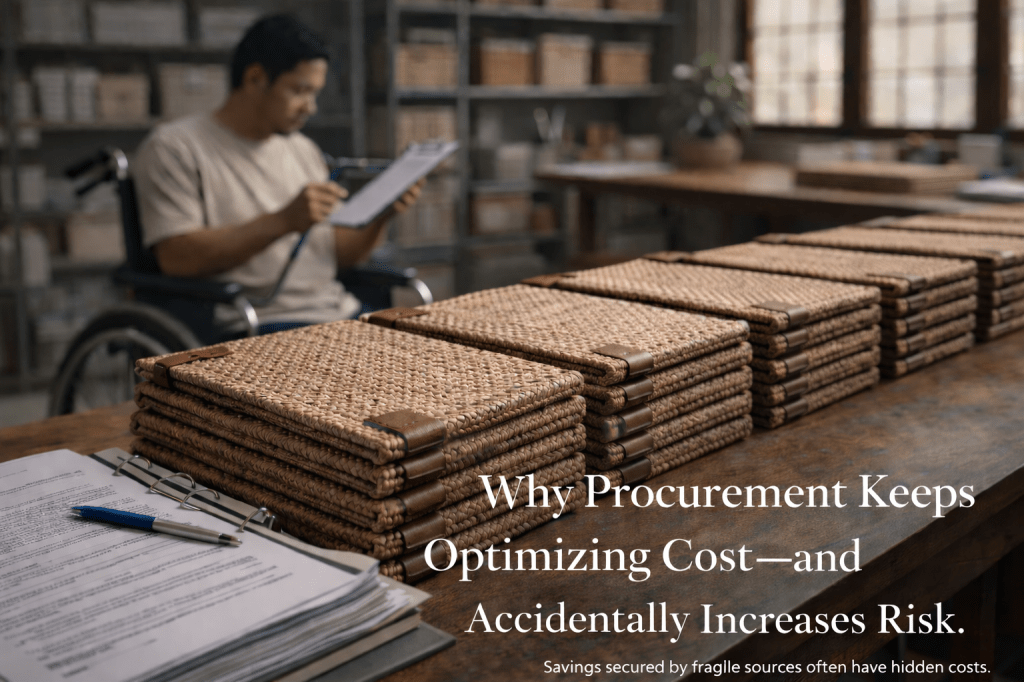
The pressure usually arrives disguised as discipline.
Reduce spend.
Hit savings targets.
Protect margins.
Procurement understands this language well. Cost control is not optional—it’s expected. And in many organizations, procurement is judged first and foremost by how much money it saves.
So teams negotiate harder.
They switch suppliers.
They compress pricing.
On paper, the numbers improve.
And yet, inside the operation, something feels off.
Despite the savings, the system feels more fragile than before.
When Savings Don’t Feel Safe
At first, the cost wins look impressive.
Unit prices drop.
Budgets loosen.
Leadership nods in approval.
But soon, small cracks begin to appear.
Deliveries become less predictable.
Quality checks increase.
Escalations start creeping back into meetings that were supposed to be routine.
Procurement starts spending more time monitoring suppliers it just “optimized.”
That’s when the uncomfortable question surfaces:
If we’re saving money, why does everything feel riskier?
The Quiet Trade-Off Procurement Is Making
Most procurement teams don’t realize they’re making a trade-off.
They think they’re exchanging higher cost for lower cost.
What they’re often exchanging—without meaning to—is stability for savings.
When price becomes the primary lever:
- Suppliers cut labor costs
- Teams turn over faster
- Training shortens
- Process discipline weakens
None of this shows up immediately.
But over time, the execution environment becomes brittle.
And brittle systems break under pressure.
Why Cost Optimization Often Increases Exposure
Here’s the uncomfortable truth.
Cost optimization doesn’t usually fail because the math is wrong.
It fails because the system absorbing that cost pressure can’t hold.
Lower prices often mean:
- Less experienced workers
- Higher turnover
- Shorter learning curves
- More improvisation on the floor
Procurement may save on the invoice—but it pays elsewhere.
In rework.
In delays.
In lost confidence.
Risk doesn’t disappear.
It relocates.
The Difference Between Cheap and Efficient
This is where mature procurement thinking diverges.
Cheap is about price.
Efficient is about outcomes over time.
Cheap suppliers often:
- Perform well initially
- Struggle under sustained demand
- Create downstream problems
Efficient suppliers:
- Stay consistent
- Absorb volume without breaking
- Reduce noise across the system
The irony is that efficient suppliers don’t always look cheapest upfront.
But they almost always cost less in the long run.
When Procurement Realized Cost Wasn’t the Real Enemy
We experienced this shift after aggressively optimizing supplier pricing—and paying for it later.
Savings were achieved.
But stability declined.
Procurement spent more time chasing updates, managing exceptions, and explaining outcomes.
Eventually, we worked with a supplier whose pricing wasn’t the lowest—but whose performance was unwavering.
Orders arrived as expected.
Quality stayed consistent.
Issues didn’t multiply under pressure.
At first, it felt like we were paying more.
In reality, we were wasting less.
Why This Supplier Didn’t Break Under Cost Pressure
The difference wasn’t technology or scale.
It was structure.
The production environment was stable:
- The same people stayed in the same roles
- Tasks were repeated, not reinvented
- Quality checks were embedded, not reactive
There was no scrambling to meet price demands.
The system absorbed pressure because it was built to.
The Detail That Explained Everything
Only later did we learn something that reframed the entire experience.
Much of the workforce consisted of Persons with Disabilities, employed through a structured livelihood program.
This wasn’t highlighted in negotiations.
It wasn’t positioned as a CSR feature.
It was simply how the system operated.
And suddenly, the stability made sense.
Why Stable Livelihoods Lower Cost Risk
Here’s the connection procurement teams rarely get to observe directly.
When people rely on work for long-term livelihood:
- Turnover drops
- Skills deepen
- Process adherence strengthens
- Pride shifts from speed to accuracy
PWD artisans weren’t moving on quickly.
They weren’t treating the work as temporary.
They stayed.
And when people stay, the system becomes resilient.
Resilience absorbs cost pressure better than any discount ever could.
This Isn’t an Argument Against Cost Discipline
Let’s be clear.
Cost discipline matters.
Savings matter.
Efficiency matters.
What doesn’t work is chasing cost at the expense of stability.
Procurement doesn’t increase risk by negotiating well.
It increases risk when savings are extracted from fragile systems.
That distinction matters—especially at scale.
What Changed When Procurement Redefined “Savings”
Once procurement stopped optimizing for lowest price alone, several things changed.
- Fewer disruptions
- Lower escalation
- More predictable outcomes
- Stronger internal trust
The savings didn’t disappear.
They became sustainable.
And behind that stability:
- Workers had steady income
- Skills compounded over time
- Livelihoods were supported by demand—not dependency
Impact followed performance.
The Procurement Insight That Reframes Cost Forever
If you lead procurement, here’s the shift that matters:
Stop asking, “How much can we save on this order?”
Start asking, “What does instability cost us over time?”
Evaluate suppliers on:
- Workforce stability
- Process discipline
- Ability to perform under pressure
- Total cost of disruption
The cheapest supplier is rarely the lowest bid.
It’s the one that doesn’t surprise you.
Why the Most Cost-Effective Systems Feel Calm
The most cost-effective procurement systems don’t feel tense.
They feel quiet.
No constant follow-ups.
No emergency meetings.
No repeated explanations.
Just work moving—predictably, reliably, sustainably.
And behind that calm:
- Stable teams
- Repeated routines
- People who protect the work because the work protects them
The Cost Procurement Was Always Trying to Avoid
Procurement doesn’t fear spending money.
It fears losing control.
And control doesn’t come from shaving another percentage point off price.
It comes from sourcing systems that hold under pressure.
Because in the end, the greatest procurement risk isn’t paying too much.
It’s saving in ways that make everything else unstable.
And the smartest procurement teams know:
The real savings are the ones you don’t have to manage later.
 Hands in Harmony
Leave a comment