
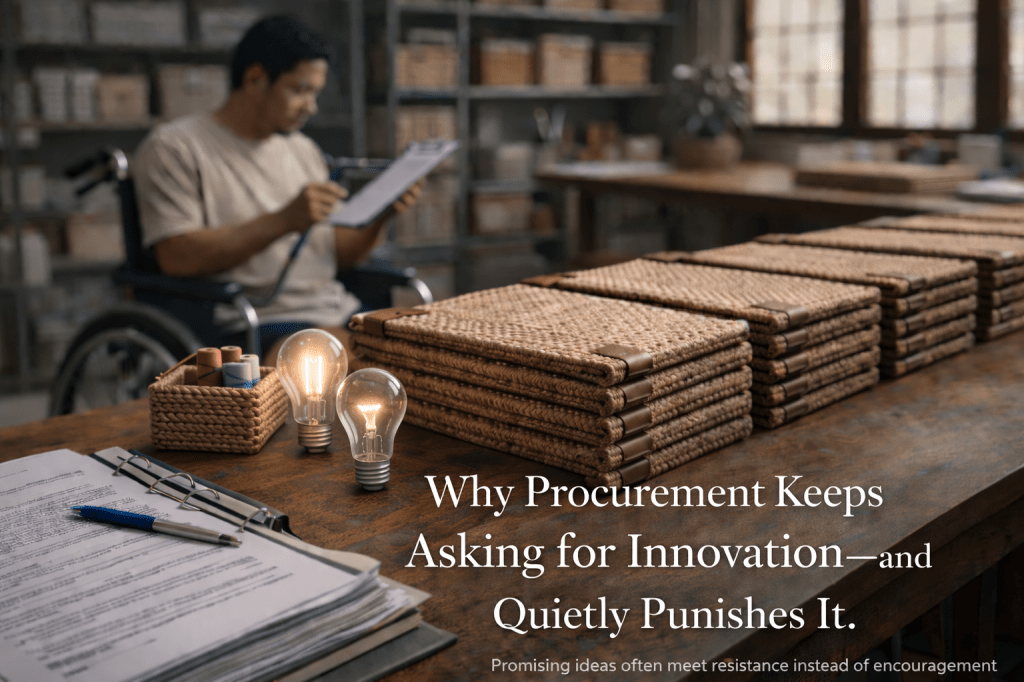
The request usually sounds inspiring.
“We want innovative suppliers.”
“Bring us new ideas.”
“Help us do things better.”
Procurement repeats these phrases in meetings, presentations, and RFPs. Innovation is framed as a shared goal—something everyone should lean into.
And yet, suppliers learn a different lesson very quickly.
The first time they try something new, it gets questioned.
The second time, it gets escalated.
By the third, they stop trying.
Innovation is asked for openly—and discouraged quietly.
The Contradiction Suppliers Learn to Read Between the Lines
Suppliers don’t need long explanations to understand procurement behavior.
They notice which actions get rewarded and which ones create friction.
A familiar pattern emerges:
- Improvements that change nothing are praised
- Experiments that introduce variation are flagged
- Anything unfamiliar triggers additional scrutiny
So suppliers adapt.
They deliver exactly what was done before.
They avoid proposing changes.
They protect themselves by staying inside the lines.
From the outside, it looks like a lack of creativity.
From the inside, it’s risk management.
Why Innovation Feels Dangerous to Procurement
This is where the conversation often gets misframed.
Procurement is not anti-innovation.
It’s anti-surprise.
Innovation introduces uncertainty.
Uncertainty feels like risk.
Risk invites escalation.
Procurement doesn’t reject new ideas because they’re bad.
It resists them because they’re unpredictable.
And unpredictability is the enemy of stable operations.
When Innovation Collides with Consistency
Procurement lives in a world where:
- Outcomes must be repeatable
- Quality must be consistent
- Variance creates downstream cost
Innovation, by definition, disrupts routine.
It changes inputs.
It alters processes.
It introduces learning curves.
Without clear boundaries, innovation can easily feel like instability wearing a clever name.
So procurement responds the only way it knows how.
It tightens controls.
It asks for more validation.
It escalates decisions.
And innovation quietly gets pushed back into safe, invisible corners.
The Hidden Cost of Playing It Safe
When suppliers learn that innovation creates friction, they stop offering it.
Not because they can’t improve—but because they don’t feel allowed to.
The result is subtle but damaging.
Processes stagnate.
Improvements slow down.
Efficiency gains plateau.
Procurement still asks for innovation—but receives compliance instead.
And over time, the system becomes very good at repeating yesterday.
Why This Isn’t a Culture Problem
Organizations often label this as a mindset issue.
They talk about “being more open.”
They encourage teams to “embrace change.”
But the problem isn’t attitude.
It’s design.
You can’t ask for innovation inside systems that punish deviation.
Innovation doesn’t fail because people lack ideas.
It fails because there’s no safe place for it to happen.
What High-Maturity Procurement Teams Do Differently
Experienced procurement leaders eventually recognize the pattern.
They stop asking:
“Why aren’t suppliers innovating?”
And start asking:
“Where is it safe for innovation to exist?”
That question changes everything.
Instead of expecting innovation inside core production, they separate it.
Stable execution stays protected.
Experimentation happens in defined spaces.
Innovation is tested—without putting operations at risk.
The Difference Between Disruption and Refinement
Not all innovation needs to be disruptive.
In fact, the most valuable improvements are often quiet:
- Fewer steps
- Better sequencing
- Reduced waste
- Clearer routines
These refinements don’t break systems.
They strengthen them.
And they only emerge in environments where people feel ownership over the work.
When Improvement Came from an Unexpected Place
We saw this shift while working with a production partner whose output kept improving—without ever destabilizing.
Processes got tighter.
Errors dropped.
Flow improved.
No dramatic changes were announced.
No big innovation decks were presented.
Improvements simply appeared—embedded in daily work.
The Detail That Explained Why Innovation Didn’t Feel Risky
Only later did we understand why.
Much of the workforce consisted of Persons with Disabilities, employed through a structured livelihood program.
This wasn’t framed as innovation.
It wasn’t marketed as transformation.
It was simply how the operation was built.
And that structure changed how improvement behaved.
Why Stable Livelihoods Enable Safer Innovation
Here’s the connection procurement teams rarely see clearly.
When people rely on work long-term:
- They care about efficiency
- They notice friction
- They improve processes quietly
- They protect consistency
PWD artisans weren’t chasing novelty.
They were refining what already worked.
Innovation wasn’t disruptive.
It was cumulative.
Small improvements, repeated over time, inside stable routines.
That kind of innovation doesn’t trigger alarms.
It earns trust.
This Is Not About Being Conservative
This isn’t an argument for playing it safe forever.
It’s an argument for designing innovation properly.
Procurement doesn’t need louder ideas.
It needs safer systems for change.
When innovation is separated from production risk, both can thrive.
What Changed When Innovation Had Boundaries
Once innovation was given a clear place:
- Core execution stabilized
- Supplier confidence increased
- Improvements surfaced naturally
- Procurement stopped reacting defensively
Innovation no longer felt like a threat.
It felt like progress.
The Procurement Insight That Unlocks Innovation
If you lead procurement, here’s the shift that matters most:
Stop asking suppliers to innovate everywhere.
Start asking where innovation belongs.
Protect stable execution.
Create room for experimentation.
Reward refinement—not disruption for its own sake.
Suppliers don’t stop innovating because they lack ideas.
They stop because the system tells them to.
Why the Best Innovation Often Goes Unnoticed
The most effective innovation rarely announces itself.
It shows up as:
- Fewer problems
- Smoother flow
- Less escalation
- Better outcomes
It doesn’t demand attention.
It earns it.
And behind that kind of innovation:
- Stable teams
- Repeated routines
- People who care about improving what they do every day
The Innovation Procurement Was Always Looking For
Procurement doesn’t actually want disruption.
It wants progress—without chaos.
And progress doesn’t come from pushing suppliers to be creative on demand.
It comes from building systems where improvement feels safe.
Because when innovation no longer threatens stability, procurement doesn’t need to punish it.
It can finally let it work.
 Hands in Harmony
Leave a comment