
The meeting usually ends on a high note.
Everyone agrees.
The slides are clear.
The next steps feel shared.
Someone says, “We’re aligned.”
And yet, weeks later, the outcomes don’t match.
Deliveries vary.
Interpretations differ.
Execution drifts just enough to cause friction.
Procurement did everything right—at least on paper.
So the question quietly surfaces:
If we were aligned, why did we still get different results?
When Alignment Becomes the Default Response
Alignment is one of procurement’s favorite words.
Align stakeholders.
Align suppliers.
Align expectations.
It sounds collaborative. Responsible. Mature.
When something goes wrong, the instinct is to align again.
Another meeting.
Another discussion.
Another round of consensus.
Alignment feels like progress.
But too often, it’s just motion.
The Comfort—and Cost—of Alignment
Alignment meetings feel productive because they reduce tension.
People talk things through.
Concerns are acknowledged.
Everyone leaves feeling heard.
But alignment has a hidden weakness.
It rarely answers the most important question:
Who decides—and how is that decision executed every time?
Without that clarity, alignment becomes flexible.
And flexibility, in execution, looks like inconsistency.
Why Alignment Doesn’t Translate to Consistency
Alignment is agreement in theory.
Execution is behavior in reality.
Between the two, interpretation lives.
Different teams hear the same agreement differently.
Different suppliers prioritize different parts of the discussion.
Different people emphasize different risks.
Procurement doesn’t suffer from misalignment.
It suffers from too much room to interpret alignment.
When “Let’s Align” Replaces Decision
In many organizations, alignment quietly replaces decision-making.
Instead of locking standards, teams keep them open.
Instead of setting boundaries, they leave space for discussion.
Instead of deciding once, they revisit often.
Alignment becomes a safety blanket.
If something goes wrong, at least everyone agreed.
But agreement doesn’t produce repeatability.
Decisions do.
The Difference Between Alignment and Clarity
Clarity is not loud.
It doesn’t require repeated meetings.
It doesn’t need constant reinforcement.
Clarity shows up as:
- Fixed standards
- Clear ownership
- Non-negotiable routines
Alignment asks people to remember.
Clarity asks systems to hold.
Procurement needs less memory—and more structure.
Why Procurement Keeps Asking for Alignment Anyway
Alignment is attractive because it feels inclusive.
No one feels excluded.
No one feels overruled.
No one feels blamed.
But inclusivity in discussion does not equal consistency in execution.
Procurement often leans on alignment when it doesn’t fully trust the system beneath it.
If execution were predictable, alignment wouldn’t feel so necessary.
When Execution Didn’t Need Alignment at All
We saw this shift while working with a supplier whose output was consistently… boring.
Same quality.
Same timing.
Same results.
There were fewer alignment meetings.
Fewer follow-ups.
Fewer clarifications.
Not because people didn’t care—but because the system didn’t require interpretation.
Execution didn’t depend on shared understanding.
It depended on shared routine.
Why Routine Beats Agreement Every Time
Routines remove ambiguity.
They don’t ask:
“What did we agree on?”
They state:
“This is how it’s done.”
When routines are strong:
- Decisions don’t travel
- Discussions don’t reopen
- Alignment becomes implicit
Procurement stops facilitating agreement and starts relying on structure.
The Detail That Explained the Consistency
Only later did we understand why execution felt so steady.
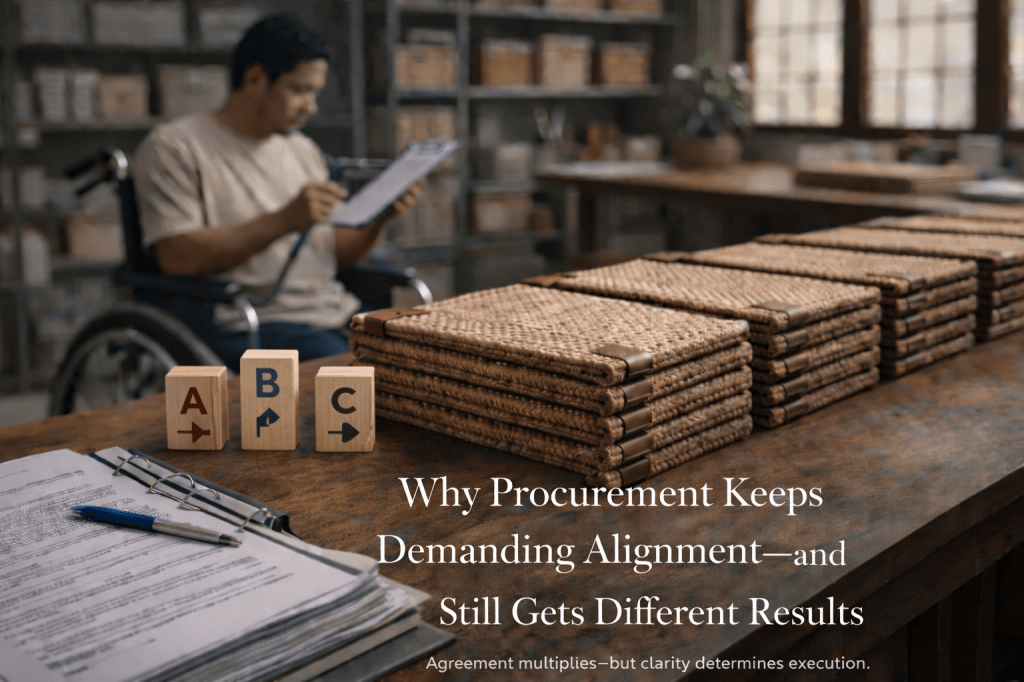
Much of the workforce consisted of Persons with Disabilities, employed through a structured livelihood model.
This wasn’t framed as a culture initiative.
It wasn’t positioned as a collaboration story.
It was simply how the system was built.
And that detail mattered more than it first appeared.
Why Stable Livelihoods Reduce the Need for Alignment
Here’s what procurement teams rarely get to observe directly.
When people rely on work for long-term livelihood:
- They don’t reinterpret instructions daily
- They don’t improvise unnecessarily
- They protect routines that work
PWD artisans weren’t debating intent.
They were executing process.
Alignment wasn’t discussed.
It was practiced.
And practiced behavior is far more reliable than shared understanding.
This Is Not an Argument Against Communication
To be clear, alignment has its place.
New initiatives need discussion.
Changes need explanation.
Stakeholders deserve input.
But alignment cannot replace decision.
And discussion cannot replace structure.
When alignment becomes the goal instead of the means, procurement pays for it in variance.
What Changed When Procurement Chose Clarity Over Alignment
Once execution standards were locked:
- Meetings shortened
- Escalations dropped
- Interpretations narrowed
Procurement didn’t need to re-align constantly.
The system carried intent forward.
Outcomes became predictable.
Not because everyone agreed more—
but because there was less to reinterpret.
The Procurement Insight That Changes Everything
If you lead procurement, here’s the shift that matters:
Stop asking whether everyone is aligned.
Start asking whether execution is unambiguous.
Evaluate suppliers and systems on:
- Routine strength
- Decision clarity
- Ownership of standards
- Ability to repeat without discussion
Alignment feels productive.
Clarity actually is.
Why the Best Systems Don’t Talk Much
The most reliable procurement systems are quiet.
They don’t require constant check-ins.
They don’t reopen settled decisions.
They don’t depend on consensus to function.
They work.
And behind that quiet consistency:
- Stable teams
- Clear routines
- People who protect the work because the work protects them
The Alignment Procurement Was Really Looking For
Procurement doesn’t want endless agreement.
It wants predictable results.
And predictability doesn’t come from more alignment.
It comes from fewer decisions left open.
Because in the end, the systems that perform best aren’t the ones where everyone agrees.
They’re the ones where everyone knows exactly what to do—every time.
 Hands in Harmony
Leave a comment