
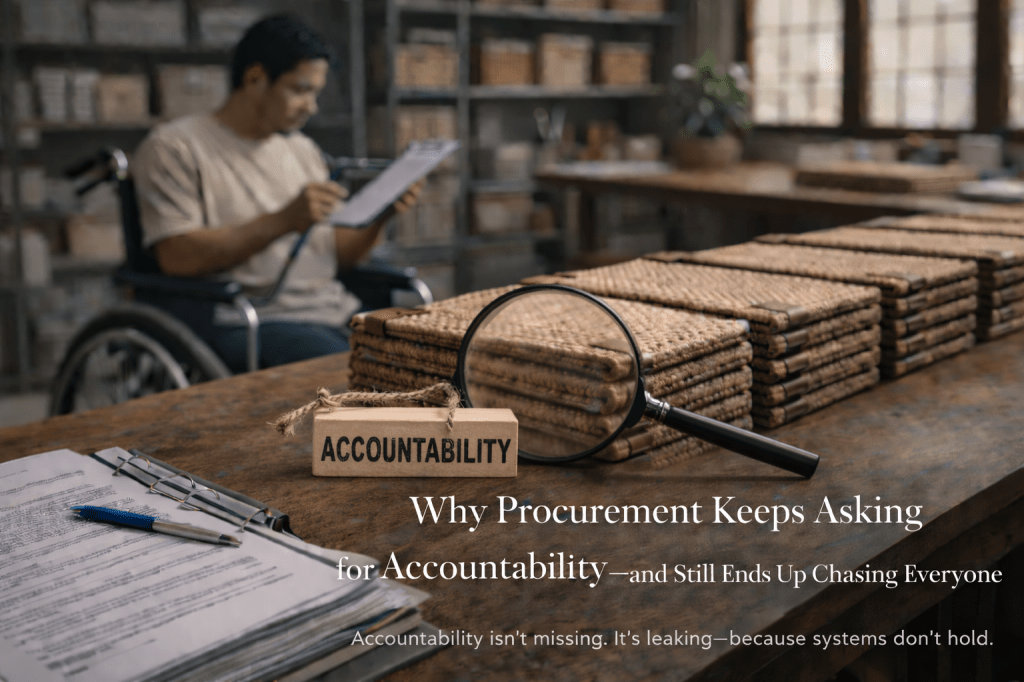
The message is clear in almost every organization.
“We need accountability.”
“Let’s make owners responsible.”
“People need to follow through.”
Procurement hears this constantly—from leadership, from operations, sometimes from itself. Accountability is framed as the missing ingredient. The thing that will finally make the system work.
And yet, despite all the talk of ownership, procurement keeps doing the same thing.
Following up.
Reminding.
Escalating.
Chasing.
If accountability is so important, why does procurement still feel like the one holding everything together?
When Accountability Becomes a Repeated Request
At first, accountability feels like a reasonable demand.
A supplier misses a deadline.
Someone forgets a detail.
An expectation slips.
So procurement responds by clarifying ownership.
Who’s responsible?
Who signs off?
Who gets copied?
Roles are defined. Names are assigned. Everyone nods.
And then… procurement follows up anyway.
Because experience has taught it something uncomfortable:
Ownership on paper doesn’t guarantee execution in reality.
The Gap Between Responsibility and Results
Most organizations don’t lack accountable people.
They lack systems that make accountability stick.
People may be responsible for outcomes, but the environment around them doesn’t support consistent follow-through.
Common signs show up quickly:
- Tasks depend on individual memory
- Outcomes vary depending on who’s involved
- Processes change under pressure
- Accountability shifts when something goes wrong
In these environments, procurement learns a quiet rule:
If I don’t follow up, it probably won’t happen.
Why Procurement Ends Up Chasing by Default
Procurement doesn’t chase because it wants control.
It chases because the system doesn’t hold.
When execution is fragile, accountability becomes reactive.
Someone has to notice.
Someone has to remind.
Someone has to intervene.
And procurement is often the last line before failure becomes visible.
So it steps in—not to dominate, but to prevent things from falling apart.
When Accountability Turns Into Surveillance
Over time, accountability morphs into monitoring.
More check-ins.
More trackers.
More status updates.
Not because procurement enjoys it—but because outcomes feel uncertain without constant attention.
Accountability becomes something that has to be enforced externally, rather than sustained internally.
And enforcement is exhausting.
Why “Holding People Accountable” Rarely Fixes the Problem
When accountability fails, organizations often respond by tightening it.
More reporting.
Stricter deadlines.
Sharper consequences.
But pressure doesn’t create reliability.
It creates compliance—at best.
People respond to pressure in predictable ways:
- They focus on what’s visible
- They manage perception
- They avoid risk
Execution doesn’t improve.
It just becomes more defensive.
Accountability Fails When Systems Don’t Carry the Load
Here’s the uncomfortable truth procurement teams eventually recognize:
Accountability breaks down when systems rely too heavily on people remembering, deciding, and adjusting constantly.
If outcomes depend on vigilance, accountability will always leak.
Strong systems don’t need to be chased.
They pull execution forward automatically.
When Procurement Finally Stopped Chasing
We saw this shift after working with a supplier whose execution felt unusually calm.
No constant reminders.
No repeated clarifications.
No daily follow-ups.
Deadlines were met.
Specs held.
Issues didn’t snowball.
Procurement didn’t need to “hold anyone accountable.”
The system already did.
Why Accountability Didn’t Need Policing
The difference wasn’t authority.
It was structure.
Work was done by the same people.
Tasks followed the same sequence.
Standards didn’t change depending on urgency.
Accountability wasn’t enforced.
It was embedded.
When execution is routine, responsibility doesn’t need reminders.
The Detail That Made the Difference Clear
Only later did we learn something that explained why accountability felt so natural.
Much of the workforce consisted of Persons with Disabilities, employed through a structured livelihood model.
This wasn’t framed as a values story.
It wasn’t highlighted in meetings.
It was simply how the operation worked.
And that detail mattered more than it first appeared.
Why Stable Livelihoods Make Accountability Self-Sustaining
Here’s what procurement teams rarely get to observe closely.
When people rely on work for long-term livelihood:
- They show up consistently
- They master routines
- They protect standards
- They take ownership naturally
PWD artisans weren’t waiting to be reminded.
They weren’t shifting responsibility.
They owned the work because the work sustained them.
Accountability wasn’t assigned.
It was lived.
This Is Not About Trying Harder
It’s important to be precise.
The issue isn’t that people don’t care.
The issue is that systems ask too much of human attention.
You can’t scale accountability through reminders.
You can only scale it through design.
When systems are stable, people don’t need chasing.
They need clarity.
What Changed When Accountability Was Designed In
Once execution stabilized, several things changed immediately.
Follow-ups dropped.
Escalations declined.
Procurement got out of the middle.
Ownership became visible—not because it was demanded, but because it was unavoidable.
The system made it clear who did what, and when.
The Procurement Insight That Reframes Accountability
If you lead procurement, here’s the shift that matters most:
Stop asking who is accountable.
Start asking what carries accountability when no one is watching.
Evaluate suppliers and systems on:
- Routine strength
- Role clarity
- Execution repeatability
- Dependence on reminders
If accountability requires constant chasing, it’s not accountability.
It’s supervision.
Why the Most Accountable Systems Feel Quiet
The most accountable procurement systems don’t feel tense.
They don’t rely on dashboards to enforce behavior.
They don’t require daily follow-ups.
They don’t escalate often.
They just work.
And behind that calm:
- Stable teams
- Clear routines
- People who protect the work because the work protects them
The Accountability Procurement Was Really Looking For
Procurement doesn’t want to chase people.
It wants confidence.
Confidence that things will happen without intervention.
Confidence that ownership doesn’t dissolve under pressure.
Confidence that responsibility survives the handoff.
And that confidence doesn’t come from demanding accountability louder.
It comes from building systems where accountability doesn’t need to be asked for.
Because when execution environments are stable, accountability stops leaking—
and procurement finally gets to stop running after it.
 Hands in Harmony
Leave a comment