
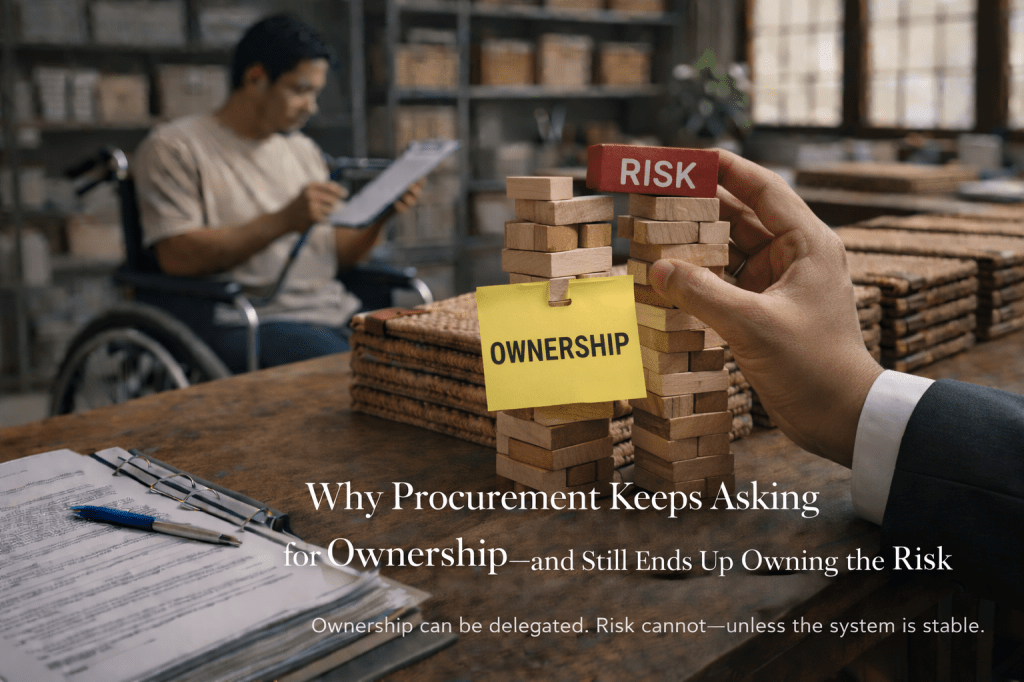
Ownership is clearly assigned.
The RACI is clean.
Responsibilities are documented.
Everyone knows who owns what.
And yet, when something goes wrong, all eyes still turn to procurement.
A supplier misses a deadline.
Quality slips unexpectedly.
A decision backfires.
Ownership was delegated—but risk somehow traveled back.
Procurement didn’t want it.
Didn’t ask for it.
But it absorbed it anyway.
When Ownership Looks Clear—but Feels Heavy
On paper, modern organizations are very good at assigning ownership.
Roles are defined.
Accountabilities are named.
Decision rights are clarified.
Procurement participates responsibly—helping set expectations, documenting responsibilities, and aligning stakeholders.
And still, procurement feels exposed.
Despite clear ownership elsewhere, it remains the function that:
- Explains what went wrong
- Escalates issues
- Manages fallout
- Rebuilds trust
Ownership exists.
But risk refuses to stay where it was assigned.
The Silent Difference Between Ownership and Risk
This is where many organizations get confused.
Ownership can be assigned in a meeting.
Risk cannot.
Risk flows toward instability.
When execution environments are weak, risk migrates upward—toward the function closest to governance, visibility, and accountability.
That function is usually procurement.
Not because procurement wants control—but because it sits at the intersection of supplier behavior, internal expectations, and external consequences.
Why Risk Keeps Sliding Back to Procurement
Procurement doesn’t end up owning risk by accident.
It happens when:
- Execution varies under pressure
- Suppliers perform inconsistently
- Processes depend on human vigilance
- Outcomes change depending on who’s involved
In these environments, assigned ownership collapses the moment something deviates from plan.
And when ownership collapses, risk looks for a new home.
It usually finds procurement.
When Procurement Becomes the Risk Sink
Over time, procurement learns an unspoken truth.
If something goes wrong:
- Procurement will be asked to explain
- Procurement will be expected to fix it
- Procurement will be judged on the outcome
So procurement adapts.
It double-checks.
It follows up.
It escalates early.
Not because it distrusts people—but because it distrusts the system’s ability to hold under stress.
Ownership exists in theory.
Risk exists in reality.
Why More Role Clarity Doesn’t Fix the Problem
Organizations often respond by refining ownership further.
Clearer RACI.
Sharper escalation paths.
Stricter accountability language.
But role clarity does not equal risk containment.
Because risk doesn’t respond to titles.
It responds to execution stability.
You can assign ownership perfectly—and still have risk move upstream if the system beneath that ownership is fragile.
The Real Question Procurement Keeps Asking Itself
At a certain point, experienced procurement leaders stop asking:
“Who owns this?”
And start asking:
“Will this ownership survive pressure?”
That question changes everything.
Because ownership that only exists when things go well isn’t ownership at all.
It’s delegation—until stress arrives.
When Ownership Finally Stayed Where It Belonged
We saw this shift while working with a supplier whose execution felt unusually solid.
Ownership was clearly defined—but more importantly, it held.
Deadlines were met.
Standards didn’t slip.
Issues didn’t escalate.
When problems appeared, they were resolved locally—without bouncing back to procurement.
Procurement didn’t absorb risk.
The system did.
Why Risk Stopped Moving Upward
The difference wasn’t authority.
It wasn’t stricter contracts.
It wasn’t heavier governance.
It was stability.
The same people did the same work.
Processes didn’t change daily.
Quality wasn’t dependent on reminders.
Ownership didn’t collapse under pressure because execution didn’t.
The Detail That Explained Everything
Only later did we learn something that reframed the entire experience.
Much of the workforce consisted of Persons with Disabilities, employed through a structured livelihood program.
This wasn’t presented as a social initiative.
It wasn’t emphasized as a differentiator.
It was simply how the system was built.
And suddenly, the behavior made sense.
Why Stable Livelihoods Anchor Risk
Here’s what procurement teams rarely get to see directly.
When people rely on work for long-term livelihood:
- Turnover drops
- Skills deepen
- Routines stabilize
- Ownership becomes personal
PWD artisans weren’t performing temporarily.
They weren’t passing through.
They stayed.
And when people stay, systems hold.
When systems hold, risk doesn’t travel upward.
It stays where it belongs.
This Is Not About Trusting People More
It’s important to be clear.
This isn’t a call for blind trust.
It’s not about assuming good intentions will solve execution problems.
It’s about designing systems that don’t leak risk.
Procurement doesn’t need to trust harder.
It needs systems that absorb pressure without collapsing.
What Changed When Risk Was Designed Out
As execution stabilized, several things shifted quickly.
Ownership stopped escalating.
Procurement stopped intervening.
Issues were resolved closer to the source.
Procurement regained its strategic role—not because it pushed risk away, but because risk no longer rushed toward it.
The Procurement Insight That Reframes Ownership Forever
If you lead procurement, here’s the shift that matters most:
Stop asking who owns the task.
Start asking what owns the risk when no one is watching.
Evaluate suppliers and systems on:
- Workforce stability
- Process discipline
- Repeatability under stress
- Dependence on intervention
If ownership collapses under pressure, risk will always climb.
And procurement will always catch it.
Why the Most Secure Systems Feel Quiet
The most secure procurement systems don’t feel tense.
They don’t escalate often.
They don’t demand constant oversight.
They don’t rely on heroic intervention.
They just work.
And behind that quiet reliability:
- Stable teams
- Repeated routines
- People who protect the work because the work protects them
The Ownership Procurement Was Really Looking For
Procurement doesn’t want more responsibility.
It wants risk to stay where it belongs.
And that doesn’t happen by assigning ownership louder or documenting it better.
It happens when systems are strong enough to carry ownership through pressure—without handing risk back upstream.
Because in the end, ownership is easy to assign.
But only stable systems can keep risk from coming home to procurement.
 Hands in Harmony
Leave a comment