
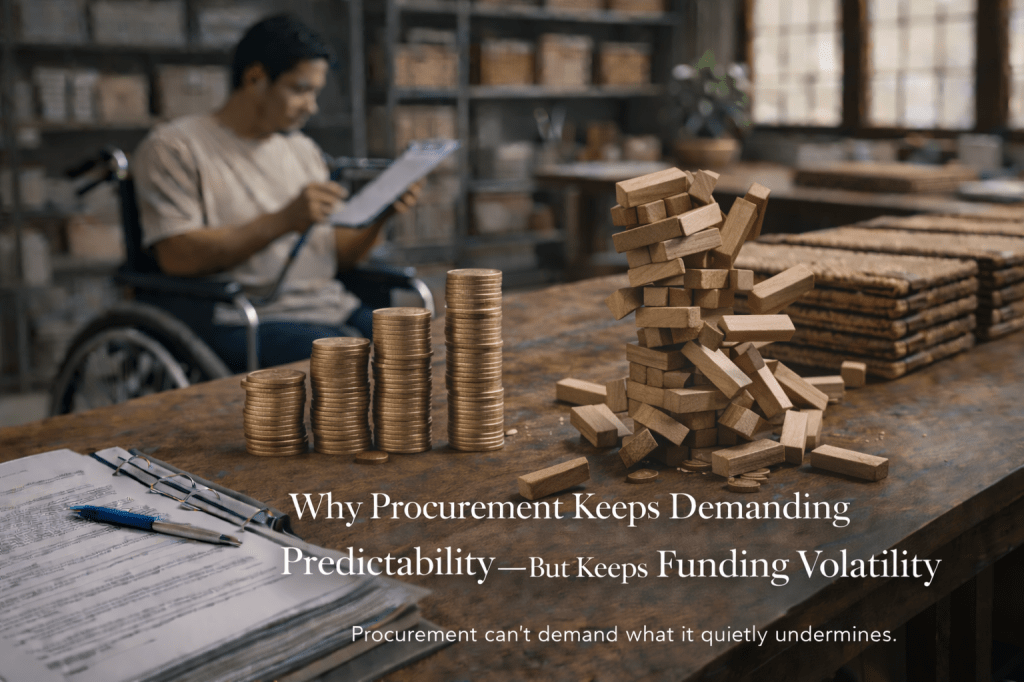
Predictability is procurement’s quiet obsession.
Forecasts must hold.
Lead times must stabilize.
Budgets must behave.
Every planning meeting reinforces the same desire:
“We need predictable outcomes.”
And yet, in many organizations, procurement unknowingly funds the very volatility it claims to fight.
Price pressure intensifies.
Supplier margins thin.
Workforces churn.
And unpredictability rises.
It’s not sabotage.
It’s structure.
When Predictability Becomes a Request Instead of a Design
Procurement often treats predictability as an expectation.
We expect suppliers to:
- Deliver consistently
- Absorb shocks
- Maintain quality
- Respond to demand spikes
But predictability doesn’t appear because it’s requested.
It appears because it’s funded.
Stable outcomes require stable environments.
And when pricing strategies quietly destabilize those environments, volatility becomes the logical result.
The Invisible Link Between Cost Pressure and Instability
Cost pressure feels responsible.
Lower cost equals higher margin.
Higher margin equals stronger business.
But cost pressure has consequences beyond spreadsheets.
When suppliers operate on razor-thin margins:
- Training budgets shrink
- Retention weakens
- Experience leaves
- Oversight increases
Procurement saves in one column and pays in another.
Not immediately.
Not visibly.
But eventually.
Why Volatility Always Moves Toward Procurement
When instability appears, it rarely announces itself.
It shows up as:
- Minor delivery shifts
- Slight quality variation
- Small execution inconsistencies
Procurement steps in to “manage” it.
Follow-ups increase.
Checkpoints multiply.
Escalations creep upward.
Volatility doesn’t stay at the supplier level.
It flows toward the function most responsible for outcomes.
Procurement absorbs it.
The Myth of Demanding Stability Without Funding It
There is a quiet contradiction in many sourcing strategies.
Procurement negotiates aggressively—then expects resilience.
But resilience is not free.
Stable labor.
Consistent routines.
Predictable output.
These things require margin.
When margin disappears, so does predictability.
When Predictability Finally Showed Up
We experienced this shift when working with a supplier whose performance barely fluctuated.
Forecasts held.
Timelines stayed intact.
Volume spikes didn’t cause panic.
Procurement didn’t need to monitor constantly.
Stability felt… normal.
What was different?
The price wasn’t the lowest.
But the system was steady.
The Detail That Made the Pattern Clear
Only later did we understand what created that steadiness.
Much of the workforce consisted of Persons with Disabilities, employed through a structured livelihood model.
This wasn’t positioned as a CSR angle.
It wasn’t highlighted in negotiation.
It was simply how the operation was structured.
And it mattered more than expected.
Why Livelihood Stability Reduces Operational Volatility
Here’s what procurement rarely sees from a distance.
When people depend on stable work:
- Turnover decreases
- Skill retention increases
- Routines become disciplined
- Output smooths over time
PWD artisans weren’t cycling in and out.
They weren’t treating production as temporary.
They built mastery.
And mastery dampens volatility.
The Difference Between Cheap and Predictable
Cheap suppliers often fluctuate.
Predictable suppliers compound.
Over time:
- Rework decreases
- Supervision reduces
- Escalation drops
- Trust increases
The cost delta between the lowest bid and the most stable supplier becomes insignificant compared to the cost of volatility.
Predictability doesn’t scream.
It compounds quietly.
This Isn’t About Overpaying
Let’s be precise.
This isn’t an argument for loose negotiation.
It’s an argument for recognizing that predictability is a system output—not a verbal commitment.
If procurement wants stability, it must design for it.
That means evaluating:
- Workforce stability
- Process maturity
- Margin sustainability
- Retention structure
Not just price.
Why Predictable Systems Feel Calm
The most predictable systems share one trait.
They don’t swing dramatically.
They don’t require constant intervention.
They don’t depend on heroic effort to meet basic expectations.
They feel calm.
And behind that calm:
- Stable teams
- Repeated routines
- People who treat work as livelihood, not transaction
The Procurement Insight That Changes the Equation
If you lead procurement, here’s the question that matters:
Are you demanding predictability—or designing for it?
Because predictability cannot be negotiated into existence.
It must be structurally supported.
And when it is, something unexpected happens:
Volatility shrinks.
Oversight decreases.
Confidence grows.
Procurement stops chasing stability—
and starts experiencing it.
 Hands in Harmony
Leave a comment